

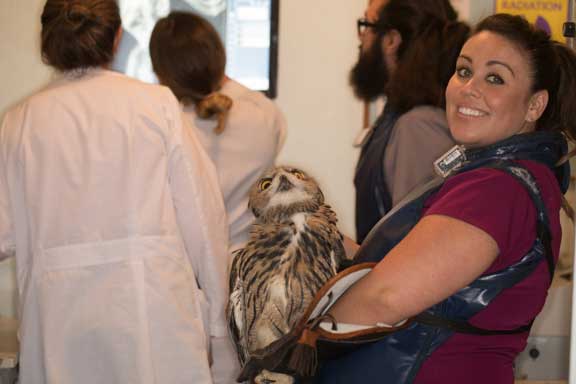
It is not easy to take a radiograph on a bird that is ill and stressed. It is a team effort, and our staff excels at it.
As you can see from the Eurasian Eagle Owl above our veterinarians provide routine and emergency care for a wide variety of avian, exotic, and domestic animals. In many cases our vets take an x-ray on pet that is an emergency, and it can be a life-saving diagnostic tool.
We work closely with Antech Imaging Services and the guidelines of the America Association of Avian Veterinarians (AAV) to provide radiographic care of birds.
This budgie is in respiratory distress, and needs a radiograph to determine what the problem is. He is first placed in 100% oxygen in order to be stable enough to take the x-ray.
The first series of radiographs are before we had our digital radiography. As you scroll down and come to the rad’s taken by our digital machine you will see the increase in quality.
If you need a primer on how to read a radiograph (do you know the five radiographic densities?) check out our link on How To Read A Radiograph first before attempting this page.

This first x-ray is from a normal cockatoo that is laying on its side, with the head towards the right

This is another normal cockatoo, this time it is laying on its back. The important organs have been labeled. Note the hourglass appearance of how the heart and liver connect.


These first two x-rays show a bird that has an abdomen filled with fluid. You cannot identify individual organs when the fluid is this extensive. Unfortunately, this is a serious condition.
This is an x-ray of a bird with an enlarged liver. The hourglass appearance between the heart and liver is not present.

This patient has lead toxicity (click here to learn more about lead toxicity)

The arrow points to lead particles in the gizzard (stomach). Do you see the fractured leg also?
This same bird is now laying on its back, and emphasizes the importance of analyzing two views of an x-ray. The fracture (arrow) in the tibiotarsal (shin) bone is more apparent now. The other arrow points to the lead particles in the gizzard. Now go back and see if you can find the fracture in the view above (hint-it is in the leg to the left). This type of fracture can be handled with a splint.

The fracture is more obvious in this view
Here is another bird with lead particles in the gizzard. You know how to recognize it now without an arrow.

The lead is brighter than all of the surrounding tissue, including bone
The arrow is pointing to a metallic object that is in the bone marrow of the femur (thigh bone). The next x-ray shows you a side view of this object.

Can you guess what this object is?
This is called an intraosseus (IO) catheter, and it has been placed in the tibiotarsus bone. It is used to give fluids, especially during an emergency. Birds have very thin walled veins and sometimes they do not hold up when we need to administer fluids. The IO catheter remedies this problem

It is literally in the shaft of the tibiotarsus bone
The following radiographs are from our new digital radiography machine. You will not how their quality is much better compared to the prior radiographs you just observed.
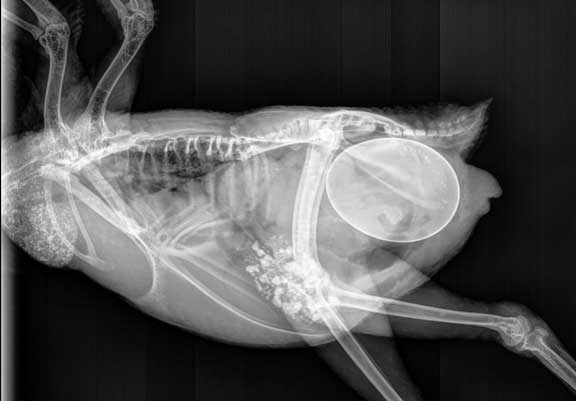
An egg stuck in a bird. Click here to learn how we treat an egg bound bird.
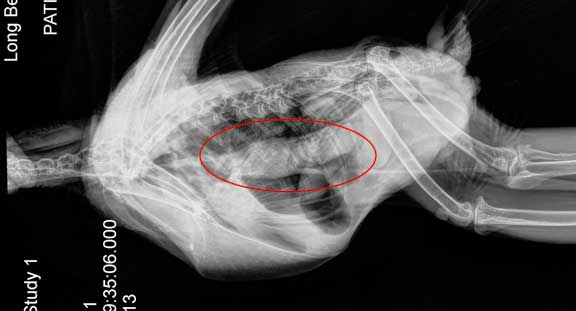
The red circle is showing the proventriculus in this bird. This is the tube just prior to the stomach (gizzard or ventriculus). This radiograph was taken to make sure this bird did not have Proventricular Dilatation Syndrome (PDS). Click here to learn more about this serious disease.
We take care of injured wildlife for free in our Wildlife Program. Click here to so some of the 1,000 injured wild animals we treat each year.

Fish hook with fishing line in a pelican

Fish hook stuck in the crop of a cormorant

Barium in the crop and intestines

A BB in the skull of a bird

This hawk has two pellets in its right wing, along with a fractured bone (radius and ulna). Can you see this?

Fractured tibiotarsus bone in a pelican

What the cervical vertebrae look like in the neck of a heron
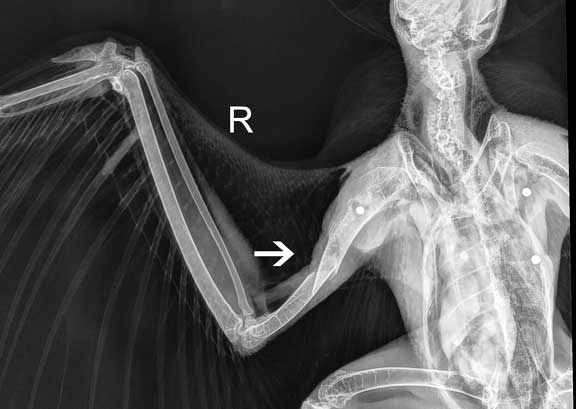
A fractured humerus in a red-tailed hawk (do you see the g BB’s also?). Our Wildlife Care Page shows the surgery to repair this fracture along with a successful release in northern California.

Fracture repair using external pins (see photo below)

What this bird looks like from the outside
A bird with a broken leg like this is an emergency. Our veterinarians are available 7 days per week to take care of exotic pets like this, so please do not wait or attempt to take care of this problem on your own. If you have an emergency always call us first(562-434-9966) before coming in so that can advise you on what to do at home and so that we can prepare. To learn more please read our Emergency Services page.