

Introduction
Demodectic mange (Demodecosis) is caused by an external parasite that is also present in low numbers on healthy animals and pets, including people. Whether or not a pet shows symptoms of this disease depends primarily on their immune status.
This disease is rare in cats, and is seen much more often in dogs, although any immunocompromised cat is susceptible.
What is Demodectic Mange?
This is a disease that is caused by a microscopic mite. It resides in the skin and hair follicles of many animals as a regular part of flora. It is when there is a problem with the immune system that this mange causes problems.
Causes of Feline Demodectic Mange
The main species that cause mange in cats are Demodex cati and Demodex gatoi.
Demodex mites are host specific. Cats cannot give it to dogs and vice versa. Neither one can give to humans. If you did a close microscopic analysis of your eyebrows you would probably find human Demodex mites there, so you have your own private species of Demodex!
Since there is no easy test to determine immune status, it is impossible to predict which cat will get this disease, or how well a cat will heal if it shows symptoms of Demodex. It is important to note that the diagnosis of this skin condition, like most skin conditions, cannot be made just by looking at a pet.
Diagnostic tests are mandatory to arrive at a correct diagnosis and achieve a satisfactory outcome to therapy. Stating that an animal looks “mangey” is not the same thing as making a positive diagnosis of mange. Pets that have Ringworm, allergies, Cushing’s or Sarcoptic mange can look like they have Demodex.
We work in conjunction with the American College of Veterinary Dermatology in caring for this disease.
Demodectic mange is caused by a mite called Demodex. It is a microscopic ectoparasite that infects the hair follicles. Most pets pick up these mites from their mother when they are nursing, and the mites do not normally cause any problems. It is those pets that have an inadequate immune system that develop this disease.

There are underlying causes that can weaken the immune system and make a pet more susceptible to this disease. These include the chronic use of cortisone, Cushing’s disease, heartworm, cancer, and hypothyroidism.
Symptoms
One of the most common symptoms of this disease is small patches of hair loss (alopecia), towards the front of the body initially, with the ability to affect the whole body. When it is present in adult cats it commonly affects the feet.
If a pet has only a few small patches of alopecia the disease is classified as localized. If it has spread throughout the body it is classified as generalized. Most pets that have Demodectic mange are young, which is a big aid in the diagnostic process.


Diagnosis
The primary way to diagnose demodectic mange is to do a skin scraping where the patches of alopecia occur. The fortunate thing about demodex is the ease of diagnosis in most cats. In most cases the mites are easy to find under the microscope, and if your pet is diagnosed as having this disease, one of our staff members will show them to you under the microscope.
A positive skin scraping of large numbers of demodex mites, along with alopecia (remember demodex is naturally found in the skin also), is verification of demodectic mange and necessitates treatment.
Treatment
We are fortunate to have several medications at our disposal to treat Demodecosis. These medications have proven to be highly effective, and have saved many pets from suffering, and even euthanasia.
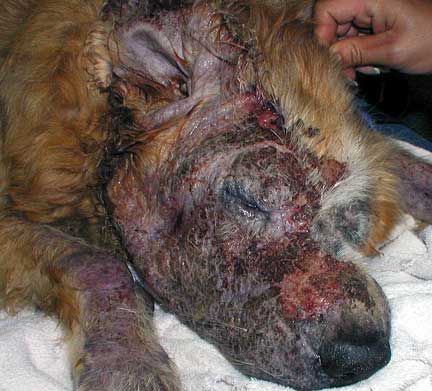
This dog has a severe case that did not respond to many different treatments because of its immune system. Unfortunately, euthanasia is the only viable option at this point.
Sometimes the most we can hope for is to control the problem, not cure it. Treatment duration needs to based on skin scrapings, not just the appearance of the skin. A skin that looks like it is healed can still harbor demodex mites.
Unfortunately, due to the fact that the immune system is paramount in whether or not your pet gets this disease, no guarantee can be made that these medications will work. No matter which form of demodex is treated, several ancillary issues need to be addressed.
Your pet needs to be on optimum nutrition, stay current on vaccines, and be free of internal parasites (worms). Like any disease process, the psychological needs of your pet need to be met, which includes plenty of exercise, TLC, and access to fresh water at all times. Other skin conditions, like allergies, can occur simultaneously, and need to be treated also.
Localized Treatment
Bathing with an antibacterial shampoo is the first step in therapy. This loosens up scales, removes oily discharges, and decreases the secondary bacterial infection that is usually present.
A benzoyl peroxide shampoo rubbed at the area of hair loss can be helpful. Rubbing it in will make the hair loss area appear larger initially. It might take up to one month for the hair loss areas to resolve.
Another treatment for localized demodex involves the use of Mitaban mixed into olive oil. This mixture is applied on the areas of hair loss daily. It is possible for localized demodex to progress to generalized demodex even if it is treated. Mitaban is no longer available.
Localized demodex might even resolve without any treatment.
Generalized Treatment
Generalized demodex is treated with a combination of medications and modalities. It is important to understand that treatment may take 2-3 months to be effective. There can be no guarantee that they will work, especially in a disease that is so closely associated with the immune system.
The hair is usually clipped to allow the topical medication easy access to the skin, which makes it substantially more effective.
Secondary pyoderma (skin infection) is usually present also, so your pet is put on oral antibiotics for several weeks to months.
Amitraz (Mitaban®) dips have been the mainstay of therapy for decades. It is effective in many cases, but side effects were possible.
Promeris, a flea and tick treatment is highly effective. Pfizer no longer makes it so it is hard to get.
Prevention
Pets that have this disease should not be bred. Otherwise, it is difficult to predict just what pets will get this problem.
Spaying infected females is helpful.