

Introduction
It is extremely rare for a specific set of symptoms to occur in only one disease, a term called pathognomic. Since almost all diseases exhibit similar symptoms, how is a diagnosis of a disease made by one of our doctors? We utilize a methodical and thorough scientific approach to help narrow down the possibilities.
This page has links to many other pages with additional detail on that topic. Have fun exploring and learning!
Signalment
A pets age, breed, and sex can be an important aid in making a diagnosis, since most diseases have a prevalence towards a specific group. The signalment helps us narrow down possibilities, and gives us a potential list of likely problems. Some examples:
- The predisposition Standard Poodles have to getting Addison’s Disease (hypoadrenocorticism).
- The predisposition terriers have to skin conditions, especially allergies.
- Young dogs tend to have more skin conditions caused by ectoparasites like Demodectic and Sarcoptic mange (Scabies) than they do allergies.
- Male cats get more urinary blockage problems than females.
- Dalmations tend to get more bladder stones of a specific type than do most breeds.
- Thyroid problems tend to occur in cats that are over 8 years of age.
History
An observant owner can be extremely helpful (and of course, the opposite holds true also) in describing the symptoms that a pet is exhibiting and the circumstances surrounding the problem. This information can be crucial to the diagnosis of certain diseases. You may notice the checklist of questions one of our nurses asks you concerning your pets appetite, activity level, etc. This is valuable information to us, especially since our pets cannot tell us where their problem is occurring.
Our exam forms help us organize the information we obtain during history taking. These forms are specific for each species and ensure that we do not miss information that is important in making the diagnosis. Our doctors read this information before entering the exam room, and then they refine it with more specific questions when they talk with you.
Physical Exam
A thorough head to tail (if they have one) exam is one of the most beneficial means of diagnosing a disease. When used in combination with signalment and history, a significant number of diseases can be tentatively diagnosed. Sometimes, when it is impossible or impractical to perform laboratory tests, the signalment, history, and physical exam are the only means available to come to an accurate diagnosis.
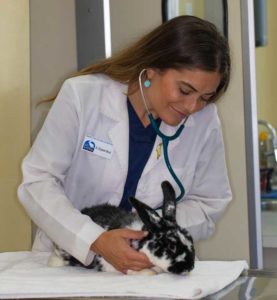
We perform exams on a wide variety of species like this rabbit

One of our student externs examining an anesthetized hawk from our wildlife program
We have a section on our website where we teach you how to examine your pet and check for early warning signs of disease. It is part of our team approach. This section is called the In-Home-Exam.
Because we work on such a wide variety of species the physical exam will vary. Abdominal palpation is important to perform on all sick dogs and cats, but can’t be done on a tortoise to the same extent. External lymph nodes are checked on all sick dogs and cats, yet they don’t exist on reptiles and birds.
Listening for heart murmurs on a dog or cat is important in the assessment of the cardiovascular system. In reptiles, due to the slow heart rate and different anatomy, murmurs aren’t heard. On birds, the heart rate can be between 300-500 beats per minute, so hearing a murmur or irregularity can be quite a challenge!

Try listening for a murmur on a baby hummer from our wildlife program that has a heart rate of over 1,000 beats per minute!
It is at this point in the process that our doctors make a list of most likely causes of the problem. This list is called the tentative diagnosis. Diagnostic tests are then recommended based on this list, which are used to rule in or rule out certain diseases. For example, if your cat has diabetes mellitus as a tentative diagnosis, yet has a normal blood sugar and no sugar in the urine, then this disease is put at the bottom of this list or maybe even completely ruled out.
Diagnostic Tests
With the increasing body of knowledge concerning traditional tests (blood samples and x-rays), and the advent of new and powerful diagnostic tests (ultrasound, MRI scans, antibody assays), diseases are being diagnosed with an ever increasing accuracy. Here are a few of the more common ones we perform routinely.
Blood Panels
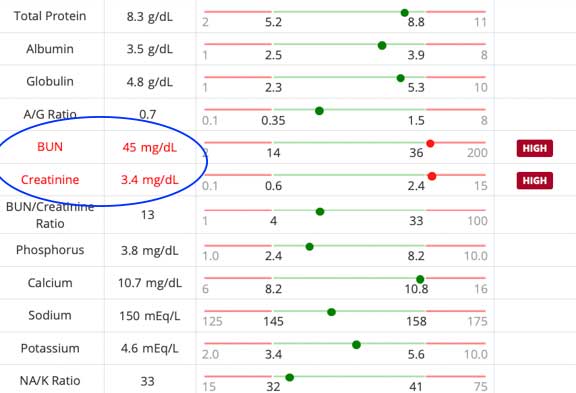
A blood panel on a cat with kidney disease
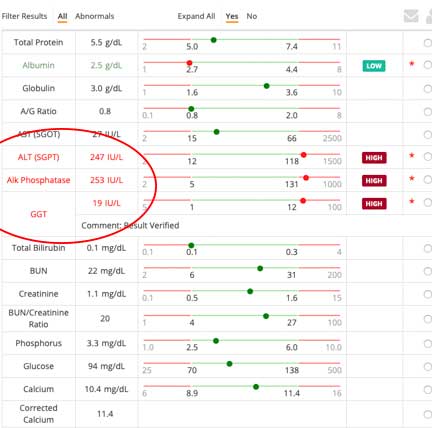
A dog with liver disease

A normal blood panel is from a 1 year old ferret, one of the many different species we work with
Radiographs (X-rays)
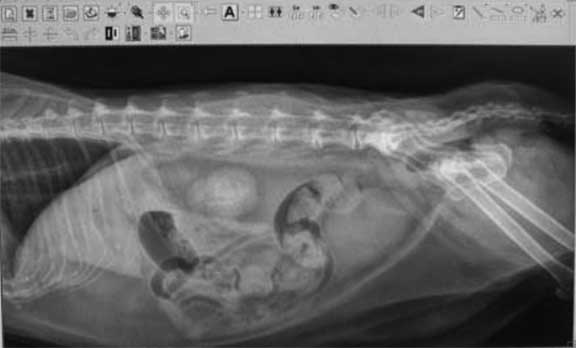
This is the radiograph of a dog with parvo virus
If you would like to learn how to read a radiograph we have a learning page called “How to Read a Radiograph“.
Ultrasound
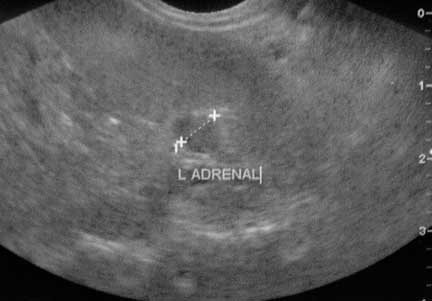
Ultrasound is very important to us. This is an enlarged adrenal gland in a ferret with Adrenal Gland disease.
We have more information on ultrasound in animals at this link.
As crucial as these tests are to an accurate diagnosis, it is extremely rare to make a diagnosis based solely on these test results without utilizing Signalment, History, and Physical Exam findings.
For sick pets we like to at least perform what is termed a “minimum data base”. This consists of a blood panel, urinalysis, and fecal exam. Other tests might be indicated based on Signalment, History, and Physical Exam.
Some of these tests require significant “interpretation”, and are influenced by how long your pet has been sick, when they are obtained, how they are obtained, how long and at what temperature they are stored, and the method of transportation to the laboratory.
Once at the lab, the skill of the technician performing the test and the experience of the pathologist are additional factors that can be of influence. Since no test is perfect, we always interpret test results in conjunction with the full picture of what is going on with your pet.
We have a page that gives you more detail on the diagnostic tests we commonly perform.
Response to Treatment
Whether a pet gets better or not from a specific treatment may help confirm or omit a diagnosis. Some diseases respond quite well to therapy, so a lack of response in a given time (this varies for each disease and how long your pet has been sick) is valuable information.