

Hyperthyroidism (thyrotoxicosis) is a common hormone disease of older cats (it’s rare in dogs) that we have diagnosed with increased frequency in recent years. It is almost always caused by a benign tumor of the thyroid gland that increases the amount of thyroxine (the hormone secreted by the thyroid gland) into the bloodstream.
This increase in thyroxine causes an increase in the overall metabolism of the body, leading to problems for several internal organs. Even though this disease can be diagnosed in young cats, most cats that get this problem are older. Cats 8 years of age or older should be screened for this problem when routine blood panels are run during a Wellness Exam.
Cats that have Feline Hyperthyroidism commonly have other problems that need careful attention if the thyroid problem is to be treated successfully. The excess thyroxine can cause these other problems, or make them worse if they already exist. Some of these other common problems are kidney disease,heart disease, dental disease, sugar diabetes (diabetes mellitus) and high blood pressure (hypertension) leading to blindness.
Just to show how unique each species is, dogs usually get hypothyroidism, the opposite problem with the thyroid gland.
Anatomy of the Thyroid Gland
The thyroid is a small and paired gland located at the neck. It is found on each side of the trachea (windpipe). If enlarged it can sometimes be palpated. We routinely check for this enlargement during our Wellness Exam.
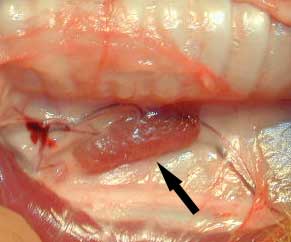
This picture shows the right thyroid of a dog. Note its location adjacent to the trachea (windpipe) above it.
Physiology
The thyroid gland utilized Iodine in food to produce thyroxine (also known as T-4 or levo-thyroxine), a hormone involved with the bodies metabolic rate. T-4 secreted by the thyroid gland gets converted to T-3 in the liver. It is now called triiodothyronine (T-3), which is the active form. When T-3 circulates through the bloodstream if affects the metabolism of every cell in the body.
Pathophysiology
The benign nodules that appear on the thyroid gland in this disease secrete excess of amounts of T3 and T4. In most cases both glands are enlarged. These hormones are not under the control of TSH (thyrotropin) secretion.
Cause of Feline Hyperthyroidism
It is caused by a benign tumor (called an adenoma) of the thyroid gland in almost all cases. This tumor produces excess amounts of thyroid hormone, which circulates through be bloodstream and affects the metabolism of many internal organs. In rare cases a malignant tumor called a carcinoma is the cause.
Why these tumors occur is unknown. Several suspected but unproven implications are:
- Cats kept indoors only
- Cat litter
- Exposure to herbicides
- Fertilizers
Cat Hyperthyroidism Symptoms
The symptoms that occur depend on which internal system or systems are most influenced by the increase in thyroxine circulating throughout the bloodstream. The more common ones are:
- Weight loss
- Excess appetite (polyphagia)
- Decreased appetite (anorexia)
- Nervousness
- Muscle weakness
- Vomiting (emesis)
- Diarrhea
- Excess drinking and urinating (polyuria and polydipsia)
- Poor hair coat
- High heart rate (tachycardia)
- Labored breathing (dyspnea)
- Mild fever
It is easy to overlook some of these symptoms, especially if they are subtle. Some people even think of these symptoms as a normal part of the aging process of cats. If left untreated hyperthyroidism can cause heart failure.
Diagnosis of this Condition
The symptoms of this disease mimic other common diseases in cats. These include kidney disease, diabetes mellitus (sugar diabetes), cancer, and liver disease.
Signalment
This problem occurs almost exclusively in middle aged and older cats. There is no know breed or sex disposition. Siamese and Himalayan cats are at decreased risk.
History
Cats with this problem will exhibit some of the symptoms noted above.
Physical Exam
During a physical exam some cats will appear thin, have racing heart rates, and even heart murmurs (click here if you would like to hear what a murmur sounds like). Sometimes we hear a specific type of heart beat called a gallop rhythm. Some cats even have thickened nails.
In some cats we can feel an enlarged thyroid gland. You might notice our doctors palpating your cat’s neck and throat during an exam to check for this enlargement. Some cats can have an enlarged thyroid gland that cannot be palpated because it has slipped from its normal position at the throat and repositioned itself further down the chest.
Diagnostic Tests
An important tool in the diagnosis of Feline Hyperthyroidism is a blood panel. We can sometimes detect the effects of the excess thyroid hormone on the internal organs by running a routine blood panel. This panel might show an elevation in the red and white blood cells. It is not uncommon to find elevated liver enzyme tests in cats that have hyperthyroidism. If the liver problem is secondary only to hyperthyroidism, it will usually resolve when we treat the hyperthyroidism.
Included in the blood panel is a specific thyroid test called a T4. Frequently this is all we need to make the diagnosis. Since thyroxine levels fluctuate, we occasionally need more sophisticated tests to make an accurate diagnosis.
A cat can have a normal thyroid test yet still have hyperthyroidism. This is because the thyroid hormone level fluctuates throughout the day or it might be early in the course of the disease. Also, these older cats can have other problems, which can suppress the production of the thyroid hormone. In these cats we will run a free T4 test. Lets look at a typical blood panel for a cat that has hyperthyroidism.

The arrows at the top point to the elevated liver enzymes tests in this cat. Note the arrow on the bottom pointing to the very elevated thyroid level. It is 18.3, the highest it should be is 5.2.
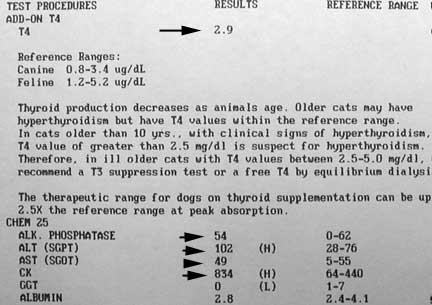
After 2 weeks of treatment the thyroid level (arrow at top) and liver enzyme levels (lower arrows) have shown a significant improvement
One of the most precise tests to diagnose hyperthyroidism is a scan of the thyroid gland. Not only is this test accurate in diagnosing the problem, it will also let us
know if some of the abnormal thyroid tissue has repositioned itself further down the chest. An additional benefit is its ability to detect a malignant cancer of the gland in the rare occasion that this occurs.
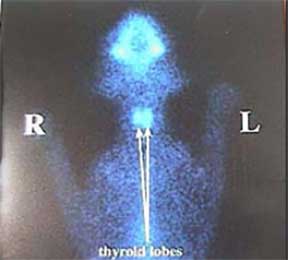
This is the scan of a normal cat. Both lobes of the thyroid gland are visible.
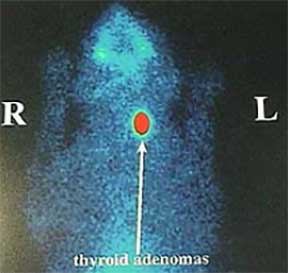
This cat has Feline Hyperthyroidism. It is the more common benign version, and is present in only one lobe of the gland.
How is Hyperthyroidism in Cats Treated?
There are four primary methods of treating this disease. Each has its advantages and disadvantages, and depends on your unique situation. One of our doctors will discuss which option is best used in your case.
Prescription Diet Y/D
This food from Hills limits the amount of iodine to between 0.17 ppm to 0.3 ppm (ppm is parts per million, which is obviously very little). All other cat foods have 1.5 ppm to 99 ppm of Iodine in them. It has been found that this reduction in iodine prevents the diseased thyroid gland from producing excess thyroxine. T4 levels stay normal and thus there are no symptoms. This food is made for older cats also that might have other diseases like kidney disease because it has limited phosphorous for the kidneys with extra omega -3 and omega-6 fatty acids. If your cat eats this food well this is all you need to treat the disease.
We recommend all cats that are currently on Tapazole (Methimazole) give this a try. Before changing your cat over we follow a specific protocol:
Gradually introduce the food over 7 days by mixing it in with the regular food.
Reduce the dose of Tapazole by 50% over this 7 days.
If your cat is eating the Y/D well exclusively at the end of the second week then stop Tapazole completely.
Bring your cat in for an exam and a blood panel with T4 level 4 weeks after starting Y/D. An exam is needed to check weight, listen to the heart with a stethoscope for murmurs, determine heart rate and blood pressure to make sure these problems that are common with Feline Hyperthyroidism are not present on just the Y/D food. In addition to checking the T4 level the blood panel checks for other problems common in older cats, especially the kidneys.
You cannot feed any other food, especially tuna, while your cat is on Y/D. Almost all foods contain excess amounts of Iodine, including some flavored chews, pills, and vitamins.
Radioactive Iodine
An excellent treatment that cures the disease completely in 98% of the cases involves the use of radioactive Iodine to selectively destroy only the part of the thyroid gland that has a problem. It has the advantage of a very high success rate and does not require anesthesia. It will also destroy the diseased thyroid tissue that has moved towards the chest. The disadvantage is the fact that your cat must be boarded at the treatment facility after treatment to minimize radiation exposure to others.. This treatment is done at a special center in Tustin, and is available only upon referral by one of our doctors. The center that performs the scan to make the diagnosis is the same place that will institute this treatment.
Before your pet is treated with radioactive iodine we will test its kidney function with Tapazole to determine if kidney function will be adequate after the radioactive iodine destroys the abnormal thyroid tissue. Please see our Kidney page to learn more about this.
Tapazole (Methimazole)
A relatively common treatment is the use of a drug called Tapazole. It is inexpensive and easy to give to most cats. Disadvantages are the fact that it never cures the problem, so a cat will need to be on it long term, and occasional cats get side effects to the drug. Fortunately these side effects are not commonly seen. For those cats that are hard to pill or have side effects to Tapazole we recommend Y/D or Radioactive Iodine treatment as described above.
It is used in cats that have chronic renal failure, a common problem as cats age. In these cats the excess thyroxine circulating can actually be an advantage to the kidneys because it increases the blood flow to the kidneys. This makes them more efficient at removing waste products. If we completely destroy the excess thyroid tissue with radiation or surgery, a kidney problem that was under control can now become serious. This is what happened to this cat, as seen on this blood sample. This told us the dose of Tapazole needed adjusting and continual monitoring.

The dose of Tapazole this cat was on brought the previously high T4 down to below normal. Everything else being equal, this is much better than being high, which is toxic to the heart.
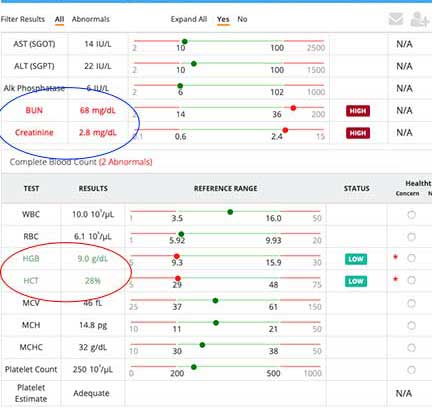
Now that the T4 is low the kidney values are going up because this cat has kidney disease that was being masked by the excess T4. Note also the anemia, a common problem in cats with chronic kidney disease.
In these situations we administer a dose of Tapazole that decreases the excess thyroxine enough to make your pet feel a little better, but not so much that it will exacerbate a kidney problem that is being masked. It is a compromise in therapy because it is an attempt to balance two problems that are occurring simultaneously.
Side effects to Tapazole include facial swelling, vomiting (emesis), lack of appetite (anorexia) and depression. They can be minimized or eliminated with proper pill giving technique (the pill is bitter) or with an adjustment in dose. We will monitor thyroid levels for several weeks after instituting this therapy to arrive at the correct dose for each cat. Every 6 months we will check the thyroid level to verify we are giving the proper dose of Tapazole.
There is a topical version of Tapazole that can be formulated by one of our pharmacies. It helps minimize the inconvenience of giving an oral medication to a cat every 12 hours. The oral version is preferred, but if you cannot give your cat oral medication this is a good option. It is not as precise as the pill, and it is hard to know just how much is being absorbed through the skin. Cats on this treatment modality need to have their T 4 tests monitored more closely to make sure it is working.
There is another medication used to treat hyperthyroidism called propylthoiuracil (PTU). It has more side effects than Tapazole, so it is not commonly used.
Surgery
Surgery (thyroidectomy) is also used to treat this condition, and can be very effective. It has the advantage of a rapid and successful cure rate. Its disadvantages are the need for anesthesia and its inability to remove diseased thyroid tissue that is in the thorax. Complications could include improper calcium metabolism, hypothyroidism (too low a thyroid level), and paralysis of the throat muscles.
Tapazole is commonly used prior to surgery to minimize the symptoms associated with this disease and make the cat a better surgical candidate.
External Beam Radiation
This is for non-functional tumors. It is not commonly used.
Percutaneous Radiofrequency Ablation
Another treatment modality that is not commonly used.
What if an Overactive Thyroid Remains Untreated?
If left untreated there are significant complications that can develop. Blindness can occur due to retinal detachment from high blood pressure. Long term kidney damage and non-stop diarrhea might also be consequences, along with heart failure and death.