Introduction
One
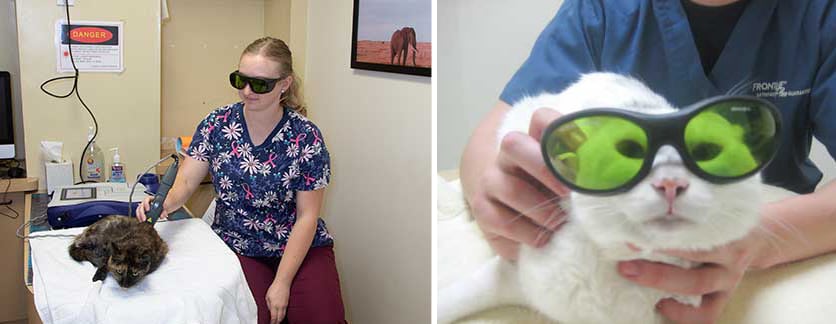
of the newest modalities we have to provide state of the art surgery is
our carbon dioxide laser. This is a proven laser that has been around
for 30 years. Only recently has it been adapted to veterinary medicine
in a clinical setting. The Long Beach animal Hospital is one of only a
handful of animal hospitals in California that have this capability.
We
have a couple of short QuickTime movies showing the laser in action.
You will need Quicktime on your machine from www.apple.com to get them
to play. If you have a modem connection to the internet they will take
a few minutes to download.
Advantages
There are several advantages to the CO2 laser surgery:
1. Pain Reduction
Your
pet will experience significantly less post operative pain in almost
every instance. As a matter of fact, the pain reduction is so great
that we perform declaws on cats only with a laser beam. This reduction
in pain is a result of the unique characteristics of the laser beam as
it cuts nerve endings, preventing the raw ends that are characteristic
of scalpel blades.
2. Swelling Reduction
Whenever
an incision is made in tissue with either a scalpel blade or scissors
inflammation is started in the affected tissue. This inflammation is a
result of interaction with the circulatory and lymphatic systems.
Because the laser beam effectively cauterizes the lymphatic system
there is much less post operative swelling. This makes your pet much
more comfortable while it is convalescing from surgery.
3. Control of Infection
The
laser beam operates at a temperature of over 200 degrees Fahrenheit.
This makes it highly effective at killing bacteria that have the
potential to cause an infection. This is particularly important in
areas where it is difficult to prevent bacteria from contaminating the
surgical site. Examples include abscesses and cat declaws.
4. Minimal Surgical Bleeding
When
an incision is made with a scalpel blade small blood vessels are cut in
the skin and the layer of tissue just under the skin. These blood
vessels can ooze throughout the surgery and even postoperatively.
Traditionally they are taken care of by clamping them with hemostats,
cauterizing, or holding gauze sponges on them until they stop. All of
these procedures take time, which means the surgery takes longer and
there is more post operatively swelling. The laser beam is a highly
effective coagulator of small blood vessels. Less bleeding during
surgery means less anesthetic time and faster recovery time.
Except
for cat declaws, where use of the laser beam is mandatory in our
hospital, the decision to use laser during surgery is made only by one
of our doctors. Even though lasers are used effectively in many
surgical procedures they are not used in every surgery. They are
especially useful in oral surgery, growth removals, and amputations of
small extremities. We also use it in small animals, especially birds,
because of the laser's great effectiveness at minimizing bleeding.
The following sections give specific examples of the use of the carbon dioxide laser in our hospital.
Declaws
This
is a particularly prevalent request for people that want to keep their
cats indoors. Prior to a declaw we advise keeping the nails trimmed
short or the administration of Soft Paws on the nails. One of our nurses will gladly give you a demonstration of these options.
Prior
to the introduction of the carbon dioxide laser all declaws were done
with a scalpel blade. It is a very precise surgical procedure that our
doctors have performed thousands of times. Unfortunately, the post
operative period was painful, the feet were bandaged, and most cats had
to stay in the hospital for several days. On older cats this surgery
was even harder on the pet.
The
advent of declaws with the laser surgery has substantially minimized
these drawbacks. There is usually no bleeding during the surgery so a
tourniquet is no longer used. Most of them can even go home the day of
surgery but we prefer to keep them for observation for 1-2 days. Most
cats have so little pain or discomfort they are jumping and running
before nature has had time to complete the healing process. Always
restrict their activity at home for the first few days to prevent this
problem.
This cat's nails have grown
into its pads due to the owner's inability to care for it properly.
This is a painful situation and makes him a candidate for a front
declaw.

The following pictures are from an actual declaw that we performed at our hospital. If you do not want to view them click here to see the paws immediately after surgery.
The
laser beam (it is invisible to the naked eye) has started the incision
at the top of the toe. It will cut through skin and tendons along with
ligaments in between the digits. Bone is not cut during the procedure.
The nail, with its attached bone (called phalanx 3), is removed.

As the surgery progresses the sides of the nail where the ligaments are located are cut. 
The surgery is complete with no bleeding or trauma to any bone. The top
arrow in this picture points to the bone at the joint of the 2nd
knuckle. The bottom arrow points to the intact pad that has not been
touched either. a drop of surgical tissue glue will be put on the pad
to cover the end of the bone.
This
is what the foot looks like immediately after surgery. There is no
bleeding or swelling and bandages are not needed in most cases.

Oral Lesions
Pets
commonly get lesions on the gum tissue in their mouths. Some of these
lesions are benign while others are malignant. Some of them cause
severe inflammation and pain, a problem that is prevalent in cats. The
laser beam excels at removing some of these oral lesions.
This dog has a large growth (arrow) that is covering its tooth. At this
time we do not know if it is benign or malignant, so it should be
removed.

The growth is being removed with the laser beam. The jaw is upside down
compared to the picture above. This is for better surgical access.

There is no bleeding during the procedure. The laser beam also
neutralizes the bacteria that are rampant in the mouth. There will be
no need for stitches or post surgical antibiotics in this case. The
gums will return to their normal pink color in a very short time. This
pet has no need for pain medication and it had its normal appetite upon
returning home. 
Ear Amputation
The
laser is particularly beneficial in amputations. Its ability to
minimize bleeding allows the surgery to progress much faster. This
section shows the amputation of the ear of a dog that has a Mast Cell
tumor. This is a malignant tumor that requires aggressive surgery if it
is to be controlled.
Ears are very vascular and bleed extensively when they are cut. as you
can see from this picture taken at the beginning of the procedure there
is no bleeding.
Four weeks post operatively healing is complete.

Skin Tumor
Another
area where it is highly advantageous to use the laser is removing skin
tumors. On some of the small tumors the lesion can be completely
ablated by the laser and there is no needs for stitches. On larger skin
tumors the coagulation of the small blood vessels minimizes operative
bleeding. Just like in the declaw, these pets have less discomfort
during the healing period because of the lack of raw nerve endings and
less inflammation.
This skin tumor is on the back of a dog. The surgeon has just started
the skin incision as evidenced by the dark line on the skin.

An elliptical incision is made around the growth to ensure that we
completely remove the whole growth and there will be no puckering of
the skin when sutures are placed.

Once the elliptical incision has been completed the underside of the
tumor is removed down to healthy tissue. This ensures that we remove
the whole tumor.

The tissue that remains has been cauterized. This kills additional
tumor cells and helps kill bacteria. This "char" is gently wiped with
saline soaked gauze to reveal healthy pink tissue underneath.

Four sutures are placed in the skin to complete the surgery. These will be removed in 10-14 days. 
Iguana Abscess
The
laser can also be used on a wide variety of species. Many of the
critters we care for are very small and cannot withstand the loss of
even a few drops of blood during surgery. The laser's ability to
coagulate the small blood vessels encountered in these cases makes it a
highly advantageous way to perform surgery.
The laser is not limited to just cutting skin. In this case it is cutting the scales of an iguana with an abscess.

We are using a forceps to gently open the abscess so we can remove the
abscessed material. If a scalpel blade had been used to make this
incision there might have been bleeding at this point.

The infected material is mechanically removed. It is very thick and
does not flow out of the wound like an abscess in a dog or cat.

In this picture the laser is performing another important function that
is unique to laser's. We are using a special tip and have set the
machine on a rapidly pulsed setting that allows us to vaporize infected
tissue that might be still present but can't be seen. 
Dog Neuter
Routine
surgeries like dog neuters can also be performed with the laser. The
minimal bleeding and post operative pain control are major reasons to
perform this surgery with the laser.
The skin incision, an area that is highly vascular in the dog, is started with the laser. 
Once we are through the skin we encounter a layer of tissue that covers the testicle.

This layer is also cut with the laser, again with no apparent bleeding.
We are now down to the last layer of tissue that covers the testicle.

The testicle bulges out of the incision as the last layer is cut.
Cutting through all of these layers with the laser takes a little
longer than the scalpel. The lack of bleeding, and of course the post
operative decrease in pain, makes it worth it. 
The testicle still has tissue attached to it that must be incised
before the testicle can be completely pulled out through the incision.
This tissue is clamped with a hemostat and cut with the laser (the
arrow points to the tip of the laser). The testicle is under the
surgeon's thumb. You can visualize the extensive blood supply of the
testicle at the bottom of the screen as the testicle is gently pulled
out of the incision. This is the area that will have 2 sutures placed
around it

The testicle has now been fully released from its connecting tissue and
has been pulled up and towards the left, exposing the start of its
blood supply and the vas deferens (the white structure). You can see
the tissue that was clamped with the hemostat and cut with the laser at
the lower right of the incision (arrow). 
The testicle has been cut, and the blood supply with its vas deferens,
with 2 sutures around them, are gently placed back into the incision.

The neuter is now complete and the surgeon is getting ready to close
the skin incision. If the surgeon decides to put in sutures that need
removing, they will be removed in 14 days.

We have a short Quicktime movie of how me make the skin incision with
the laser. Double click on the movie to get it to start.
|