

Introduction
A common surgery performed on female rabbits is a spay. The medical term is an ovariohysterectomy (removal of ovaries and uterus), abbreviated as an OVH. This page will show actual spay surgeries, on a rabbit with a fluid filled uterus, on a rabbit with uterine cancer, and on a normal rabbit.
To learn more about rabbits in general, visit the House Rabbit Society website.
What is Rabbit Spaying?
Spaying is removal of the ovaries and uterus of female rabbit.
Why Spay Your Bunny?”
Spaying prevents a serious uterine infection called pyometra that is not uncommon in female rabbits that are not spayed. It also prevents your rabbit from going into heat and getting pregnant, and tends to make your rabbit calmer in many cases.
Diseased Uterus
Rabbits get many uterine problems, all preventable if a rabbit is spayed early in life. The problems can be so serious as to be life threatening. Unfortunately, by the time a rabbit owner notices a problem, the problem has progressed to the point that it cannot be corrected in some cases, and the rabbit dies a painful death from this infliction.
Sometimes the uterus is grossly distended with fluid. This is painful, and causes significant problem with the other organs.
In addition, rabbits normally have a small chest in relation to the size of the abdomen. When the abdomen becomes enlarged with an infected uterus this makes breathing difficult. Rabbits are especially hard hit when this happens, and they can succumb to this.

This rabbit radiograph shows a significantly distended abdomen. The distention is due to a uterus completely filled with fluid.
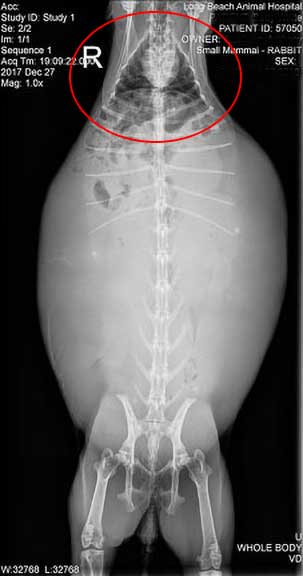
This is the same rabbit laying on its back. Even though rabbits normally have a large abdomen, this one is particularly large, making it hard for this rabbit to breathe. The thorax, containing the white colored heart and black colored lungs, is circled in red.

This picture during surgery to remove it shows how distended this uterus is. In addition to the pain from the distention, the uterus takes up room in the abdomen that would normally be used for digestion from the large cecum.
A rabbit with this much distention literally does not have room to eat the food it needs. Our rabbit GI stasis page shows the cecum in the abdomen to visualize this.
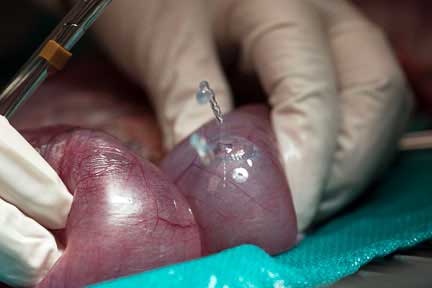
The uterus is filled with fluid. This is painful, and a rabbit can succumb to this pain.
Another problem of the uterus in rabbits is cancer. If a rabbit is spayed early in life it will not get this painful and life-threatening cancer.

This is what a healthy rabbit uterus looks like during surgery
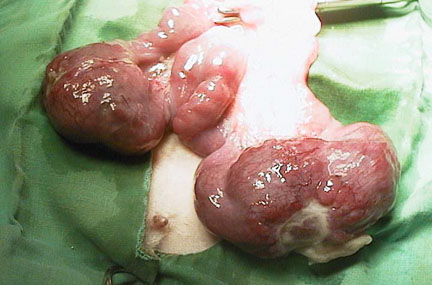
This uterus is filled with cancer

This is a necrotic uterus that has cancer
When to Spay a Rabbit
Just like in most every female pet, early spay is recommended in rabbits. This means at around 6 months age.
How is a Rabbit Spayed
Preparation
Pre-surgical preparation is a big part of any surgery at our hospital. This includes a pre-anesthetic physical exam and blood panel. If we suspect a serious uterine problem we will also take a radiograph as you have seen above. We even do ultrasounds on some rabbits.

Before we perform any surgery our rabbit gets a thorough physical exam
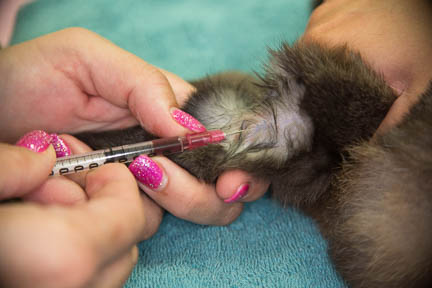
We also check a blood panel prior to surgery to make sure there is no anemia and that the liver and kidneys are working normally. It is not easy to take a blood sample on a rabbit. We use a tiny needle since the vein is so small.
Surgery
Once all of the pre-anesthetic exams and diagnostic tests are complete we are ready for surgery.
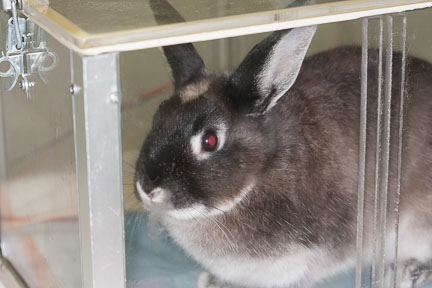
We use a gas anesthetic that lets them fall asleep without any stress and is very safe. You can learn much more on how we anesthetize the wide variety of animals we care for at our hospital from our anesthesia page.
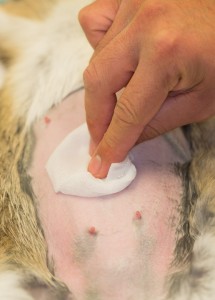 Once they are anesthetized we carefully clip the hair. After clipping, the next step in preparation is the initial cleansing of the skin with a special surgical grade disinfectant
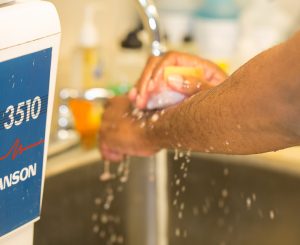
While our patient is being prepped our surgeon is doing the same thing

After thoroughly cleansing his/her hands our surgeon wears completed surgical garb for the spay
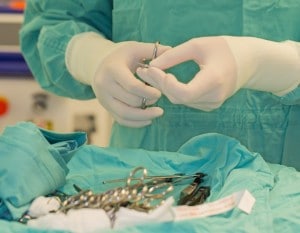
Time is of the essence any time a pet is under anesthesia, so our surgeon gets all instruments ready while our anesthetist is prepping our patient
All of our surgeries are closely monitored using our surgical monitor. These instruments detect a problem before it becomes detrimental to our patient.
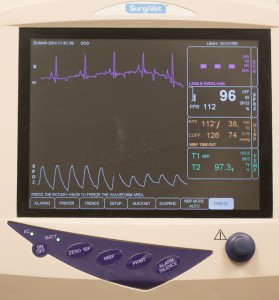
The monitor assess many important physiologic parameters related to anesthesia
Anesthetic monitor video. The background noise is the oxygen generator.

We don’t just rely upon monitoring equipment, and use a hands-on approach to our surgical patients
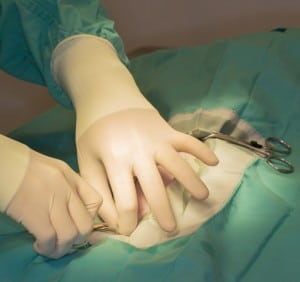
Once our surgeon is comfortable that everything is in order, our patient is draped and the procedure begins
Of all the different species we spay rabbits have the most delicate tissue. This applies to our initial skin incision, any time we give an injection or clip the hair, and throughout the surgery.
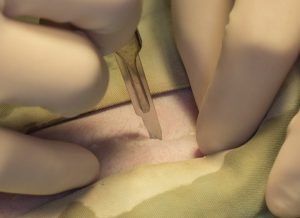
Rabbits have minimal fat under the skin, so the skin incision is delicately made with a small scalpel blade
Once the skin has been incised our landmark is a tendinous attachment of the abdominal muscles called the linea alba. It is important that we make our abdominal incision here, because there is negligible bleeding, and this area gives the sutures holding power to prevent a hernia.
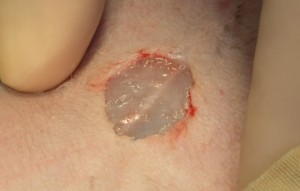
The linea alba is seen here as the while diagonal line
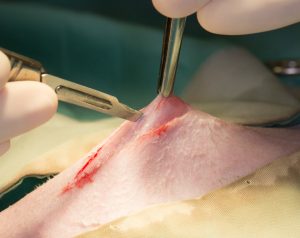
When our surgeon has identified this landmark an incision is made into the abdomen
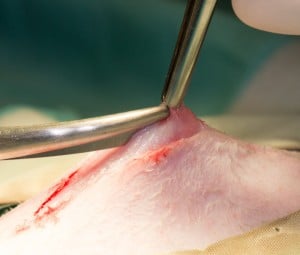
This incision is continued with a scissors until it is just big enough to remove the ovaries and uterus
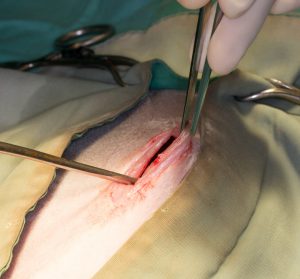
Once the incision is large enough a special instrument is used to gently bring the ovaries out of the small incision. The use of this instrument allows us to keep the incision small, which of course has obvious advantages regarding the amount of post surgery pain and speed of healing.
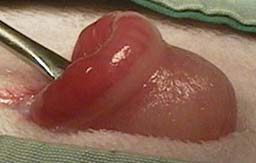
We use the special spay hook to gently pull a uterine horn out of the incision
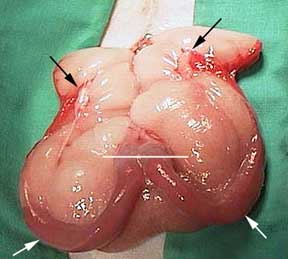
Older rabbits have a significant amount of fat around the ovaries (black arrows) and along the uterus (white arrows). Both ovaries will be removed, and the body of the uterus will be removed at the point of the white horizontal line. The head of the rabbit is towards the top on this view.
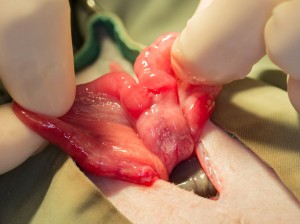
Younger rabbits do not have as much fat, although their tissue is more delicate and can tear easily. The head of the rabbit is towards the bottom right in this view, opposite of the view above.
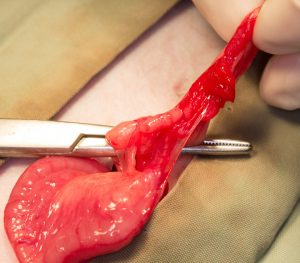
The ovary is pulled out of the abdomen and clamped for removal. You can see the ovary as the small horizontal cream colored tissue in the center above the clamp. It is removed completely during the surgery.
Special care is taken to make sure there is no bleeding after the ovary is removed. Several clamps are used, and several sutures (called ligatures) are put on the vessels that supply blood to the ovary. The next 3 views show our surgeon in the process of accomplishing this before the ovary is removed.
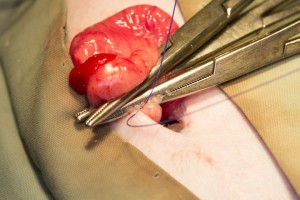
The unseen ovary is buried buried in the fat just above the clamp. In this photo our surgeon is putting a ligature on the blood supply to the ovary.
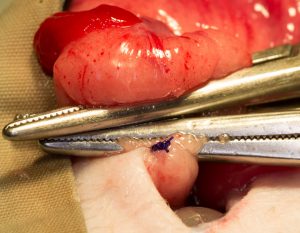
The first ligature has been placed. The knot of this suture can be seen under the lower clamp.
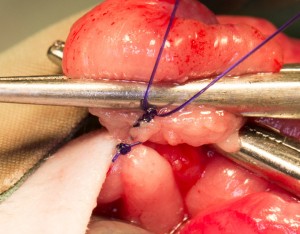
The second one is in the process
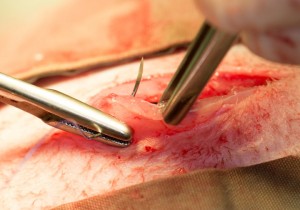
Once both ovaries and uterine body are ligated and removed the incision in the linea alba is sutured. A special non-reactive and strong suture is used, that will slowly dissolve over several months.
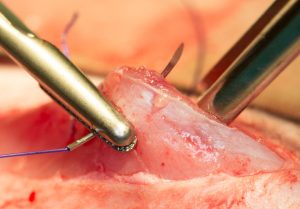
Our surgeon takes extra care to make sure they are put in properly in the linea alba to prevent a hernia

The final row of sutures in the linea. They are non-reactive, and will slowly dissolve internally over several months.
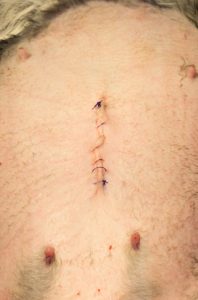
The final row of sutures in the skin. They will be removed in 10-14 days.
Far too often people have the attitude that pets don’t have pain because we just don’t see it. We prefer to err on the side of more pain control than less pain control. Those of us that have had abdominal surgery know how painful it can be, so we make sure pain control is in our surgical plan.
Post-operative care for a spayed Rabbit
Before our patient wakes up we use the therapy laser to minimize post operative swelling and enhance the healing process. Any natural thing we can do to aid the healing process is part of our approach of treating our patients like we want to be treated if we are in a similar situation.
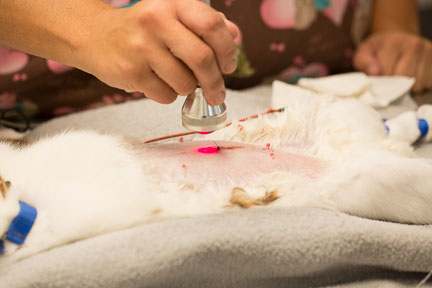
While our patient is waking up from anesthesia we use the companion laser
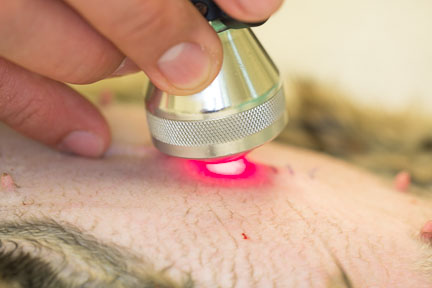
It gives off a gentle warmth as it does its work to minimize pain and swelling after the surgery
after the surgery
Therapy laser post op on a dog neuter
We also give a pain injection we give before our patient wakes up. This pain injection will last until the evening. Our patient will go home with oral pain medication also.

Our nursing staff closely monitors all patients immediately post operatively and keeps them warm until they are fully awake
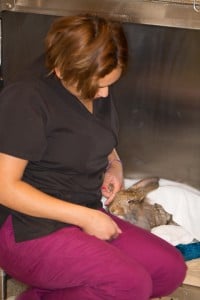
Once they are awake they are given lots of TLC and closely monitored for pain
Return to Rabbit Diseases page.