

Introduction
On occasion a dog or cat will dislocate its hip. Learn what to do if your dog dislocated its hip, and the procedures and surgeries to correct it from the experts at the Long Beach Animal Hospital.
What is Canine Hip Dislocation?
The medical term that is sometimes used for this problem is luxation or subluxation. This is when one of the heads of the femurs (the ball) comes out of the hip socket. Even though we use the term “hip”, the problem is actually the head of the femur that has come out of the hip socket.
Signs of Hip Dislocation (Subluxation)
A pet with this problem is overtly limping on one of its rear legs. (joint support supplements for dogs can help improve mobility and recovery)
It usually holds the affected leg high in the air, and is unable to bear any weight on it. If you touch it the leg is usually painful.
(Pain relief supplements for dogs may help reduce discomfort)
Causes of a Dislocated Hip
This is usually due a traumatic incident like being hit by a car, or jumping from a high spot, or being kicked in the area of the hip socket.
(Having a pet first aid kit for emergencies is important for immediate care)
Some small breed dogs are born with an abnormal hip socket that can might a dislocation. It is called Legg-calve -perthes disease, although that is rare. In this case the ball at the top of the femur erodes due to a poor blood supply.
Diagnosing Canine Hip Luxation
A history of holding the leg up after a potential traumatic incident is the first clue. Palpation of the area reveals pain when we rotate the hip socket.
The exam gave us clues that the pain is caused by a dislocation. When we gently extended the rear legs (depending on the type of dislocation) the dislocated leg appears shorter than the normal leg. The diagnosis is confirmed with x-rays (radiographs) after an initial examination.
(Keep your pet calm during vet visits with calming treats for dogs can make the process easier)

These are normal dog hip x-rays. This is called the VD (venture-dorsal) view because the dog is laying on its back.
This is the lateral view where the dog is laying on its side

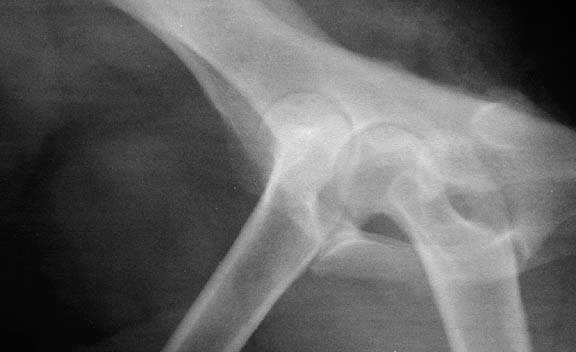
This x-ray is of a dog with a dislocated hip. The ball of the left femur is completely out of the socket. Ligaments and the joint capsule have been torn for this to occur.
It is important not to confuse this disease with a fractured hip (pelvis). A fractured hip is technically a problem of the femur, where the head of the femur at the neck has been broken. This is the same problem that elderly people get when they fall and break their hip. Now you know that it is technically not the hip that is fractured, but since that is the terminology non-medical people have always used, most people leave it at that.
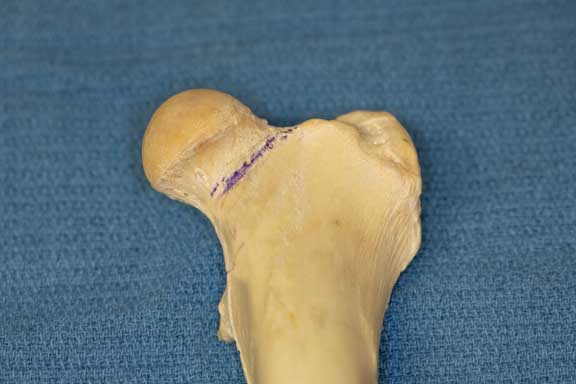
The purple line in this model of the femur demarcates where the fracture occurs at the neck of the femur

This x-ray shows what that fractured head of the femur looks like radiographically
How are Dislocated Hips in Dogs Corrected?
Medical Correction- non surgical or closed reduction
Some pets with dislocated hips can be corrected without the need of surgery. Whether or not this occurs depends on the extent of the damage, especially to the ligaments, tendons, and joint capsule.
This pet was anesthetized and the head of the femur was gently placed back into the socket. It was securely taped so that the femur was held firmly in the socket. a special type of sling was applied to keep the head of the femur (the ball) pushed back into the socket.
(Using dog support slings can aid recovery and mobility)
This method is not always successful, but it is worth trying to prevent surgery.

A radiograph is taken immediately after application of the sling to be certain the femoral head is still in the socket. One week later we repeated the x-ray to be certain it was still in place.

You can see the folded leg under the bandage, with the head of the femur (the ball) still in the socket
Pain medication will be given to minimize discomfort. This dog will need to be confined and have minimal activity for several weeks.
Surgical Correction (open reduction)
In many cases we have to resort to surgery to correct the dislocation. It is a surgery that is performed by an experienced orthopedic surgeon at our hospital to make sure the outcome is a pain-free dog that does not get arthritis when it is older.
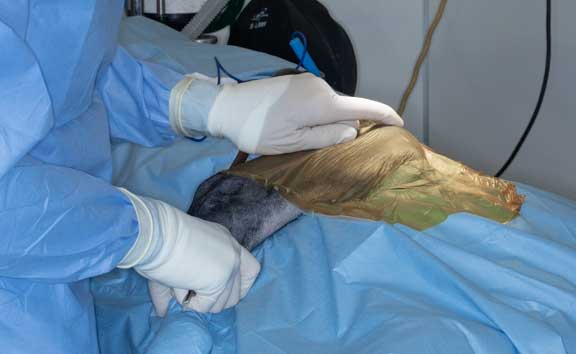
Our surgeon is pointing to the greater trochanter, his landmark before he makes his incision
We have a complete page dedicated to this surgery surgery
Frequently Asked Questions (FAQ’s)
What is the Healing Time?
A dog treated with a closed reduction usually heals within 2-4 weeks with the sling. A dog treated surgically (a more common treatment than the sling) usually heals within a month.
Can a Dog’s Dislocated Hip Heal on its Own?
The hip will never go back into the socket on its own, and the continual trauma to the area while not only be painful, it can cause so much trauma to the soft tissues in the area (muscles, ligaments, nerves, blood supply) that the leg might need to be amputated.
Summary
For as much time as dogs spend outdoors running around and being exposed to potentially traumatic situations this hip problem is fortunately not that common. Anytime your dog is limping it should be seen by one of the doctors at the Long Beach Animal Hospital to determine the cause and get it treated immediately to prevent long term damage and the high potential for painful arthritis to set in. In most cases surgery will be needed to remove the head of the femur and form a false joint. Dogs with the surgery return to almost perfectly normal function in a short period of time.