

Introduction
Australian Shepherds are a very intelligent breed with a strong herding instinct. Overall they are hardy and easily adapt to different settings. They are active and high energy dogs that need plenty of room to run everyday.
Aussies are predisposed to certain diseases, so careful observation of your pets daily routine is important. Any significant changes in this routine are cause for an examination. A few of the more common problems of Australian Shepherds will be described in this page.
Our web site in the Diseases Section has detailed medical information on many of the diseases we see in Aussie’s.
Common Australian Shepherd illnesses
Eye Problems
Eye problems can occur at many different ages. Some involve the eyelids while others involve the internal structures of the eye. In some cases symptoms are apparent, while others need a thorough ophthalmic exam.
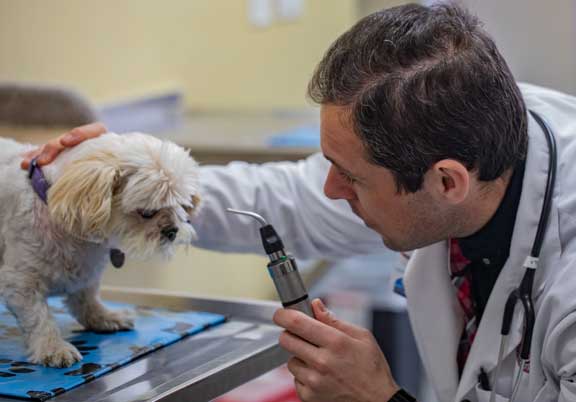
An eye exam with an ophthalmoscope
Eye problems range from hereditary cataracts to iris coloboma’s. The prevalence of these problems emphasizes the need for early examinations by one of our doctors, or anytime you notice a problem with the eyes.
Progressive Retinal Atrophy (PRA)
In PRA there is gradual deterioration of the retina, the back part of the eye that senses light. This needs to be diagnosed early by a veterinary ophthalmologist to be able to help your dog adapt to the gradual loss of eyesight.
This disease typically manifests itself in adults dogs up to 9 years of age. There is a form that can occur in puppies.
There is no cure and it cannot be treated. In the early stages your dog cannot see well, especially at night. You might notice it bumping into things when the light is not good. Since dogs use their sense of smell and hearing much more than we do, and they do not drive cars (unless in the movies), and do not have a social stigma about this disability, many can adapt.
Though it’s not a painful condition for dogs, there is no current effective treatment or cure for PRA. The first signs of PRA are typically night blindness and increased clumsiness (walking/bumping into things). However, because dogs rely heavily on other other senses as well, they can live long, happy lives without vision.
PRA is an inherited condition, so dogs that have been diagnosed should not be bred. You can learn more about PRA by clicking here.
Hereditary cataracts
Symptoms of hereditary cataracts can occur in Aussies starting from one year of age. It is an inherited disease.
In this disease the lens becomes too cloudy to see properly, just like in people. It can progress and even lead to painful glaucoma. Surgery is the best option when recommended by a veterinary ophthalmologist.
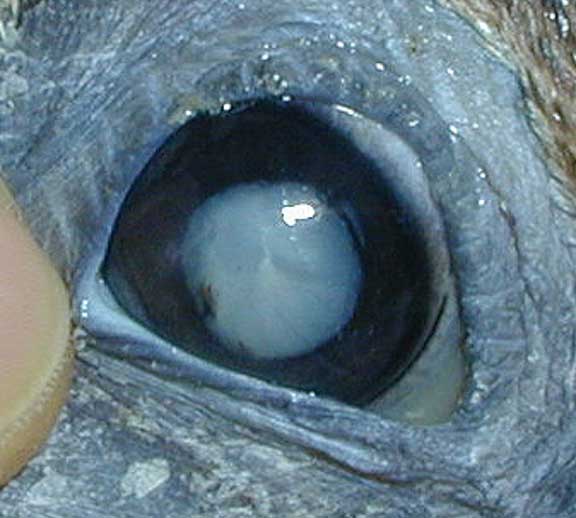
This is what a cataract looks like. Can you guess the species? It is a pelican from our Wildlife Program. In this program we provide free care for injured wildlife.
Iris Coloboma
In this problem the iris fails to develop properly, and can be too small or too large. Too small is not a problem, but too big causes a sensitivity to light and lead to discomfort. Goggles can help, but a dog with this problem should be kept out of direct sunshine.
Dogs with this problem should not be bred, and added to the Canine Eye Registry Foundation (CERF) after confirmation by a veterinary ophthalmologist.
Epilepsy (seizures)
This is an inherited problem with no genetic test to screen it out of the breeding pool, We have a detailed page on this form of epilepsy, called idiopathic.
Multidrug Resistance Mutation
The MDR1 gene can be detected with a DNA test. Dogs that have this condition tend to be herding breeds. This gene affects how affected dogs metabolize certain drugs and medications, especially those in tick and flea products. This can lead to more side effects.
Deafness
Dogs whose parents are merle colored have a lack of pigment in their eyes. This can lead to deafness. There is a test for this called the Brainstem Auditory Evoked Response (BAER) to help in diagnosis in deafness.
Lymphosarcoma
This is a cancer of the lymph nodes. When diagnosed early enough chemotherapy can be effective.

The sub lumbar lymph are circled on this dog with cancer
Hemangiosarcoma
This is a tumor of the spleen and sometimes liver. It is malignant, and unfortunately symptoms are not usually present until your dog is bleeding internally or collapses. It is such an important disease we have a full page on Hemangiosarcoma.
Sunburn (Nasal Solar Dermatitis)
These Aussies are particularly susceptible to nasal solar dermatitis, sunburn of the nose. The symptoms of this problem mimic skin conditions caused by autoimmune problems, so any change to your pet’s nose is a reason for an exam by one of our doctors. To help prevent this potential problem, minimize exposure to the sun and use sunblock if possible.
Red Blood Cell Diseases (Von Willebrand’s)
Problems with the red blood cells are not uncommon. This can cause anemia and bleeding disorders (the most common one is called Von WIllebrand’s). Watch for lethargy, easy bruising, nosebleed, bleeding gums, bleeding in the stomach, limping, or blood in urine or stool.
Von Willebrand’s cannot be cured, and is often treated with a blood transfusion to give your Dobie a good quality of life.
This disease can be tested for, and any dog that is positive should not be bred.
Perform a weekly exam of your DP’s mucus membranes (gums) to make sure they are pink and that there is no petechial hemmorhage.
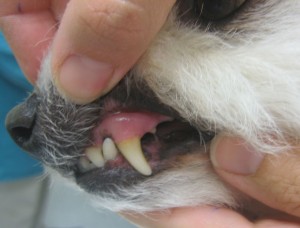
The gums on this dog are nice and pink, just the way we want to see them
Our Learning Center located on the Home Page shows you how to do an in-home exam to check for this.
Orthopedic Problems
Arthritis
They are also prone to arthritis. Fortunately, we have many effective treatments that can dramatically improve your dog’s quality of life.

The arrow points to arthritis of the knee in a dog. These boney deposits (from a dog with RCCL) are painful.
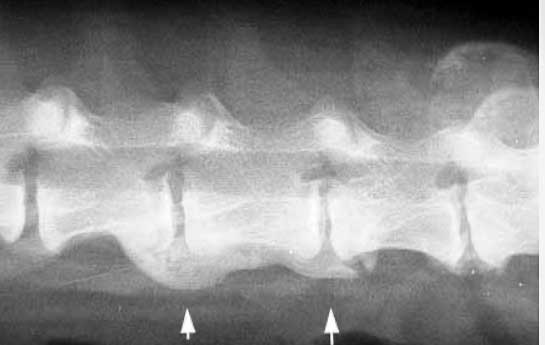
The arrows point to arthritis of the spine (called spondylosis) of the lumbar vertebrae
Hip Dysplasia
This is a problem with malformation of the hip sockets that leads to arthritis and significant pain and lameness in many cases.

These hips are normal
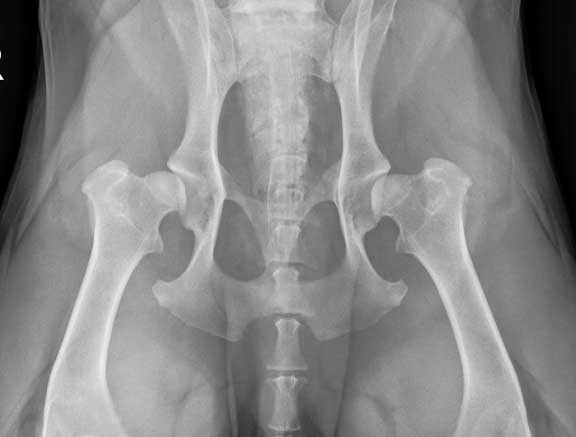
These are dysplastic hips. Can you tell the difference from the normal hips in the radiograph above?
There is much more to be learned regarding this serious disease. Our Hip Dysplasia page has all the details.
Elbow dysplasia also occurs in this breed.
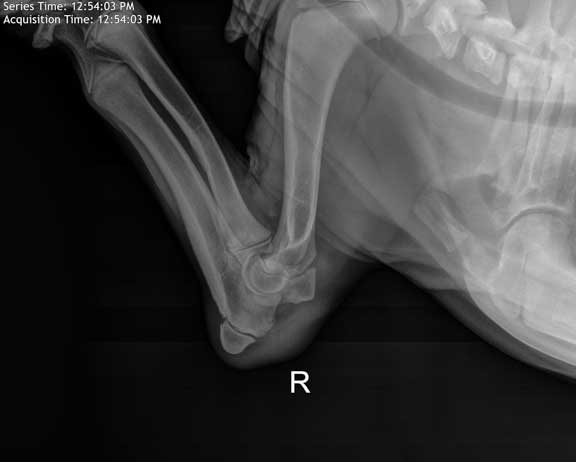
A radiograph is needed to diagnose elbow dysplasia.
Seizures
Heart Disease
A heart disease called Patent Ductus Arteriosis (PDA) can be a problem, and is seen more often in females. Some pets have no symptoms while other pets may show some respiratory signs. Exercise may worsen any symptoms.
Any symptom of lethargy, coughing, poor appetite, or exercise intolerance could be a sign of a heart problem and should be investigated. We check for a PDA when we listen to your puppy’s heart with our stethoscope when it comes in for routine exams.
Another common problem in Aussie’s as they age is mitral valve disease (MMVD). This is noted as a heart murmur on a physical exam using a stethoscope to perform auscultation on the heart. You can learn much more about this in our Heart Disease page.
By using genetic testing and registry programs like these, breeders of purebred dogs can work toward eliminating these inherited diseases, which can lead to lifelong pain, debilitation and medical problems. If you’re considering getting a purebred puppy, asking potential breeders about these inherited diseases can help you choose a healthy pup.