

Oral hygiene is one of the most overlooked areas of medical care for dogs and cats. As we increase our knowledge of animal health we realize that proper dental care does not just make your pet’s breath smell better; it is mandatory for your pet’s long term quality of life. Dental disease is a treatable and preventable problem, and since your pet cannot tell you how it feels, it is up to all of us, as members of your pet’s health care team, to address this problem.
This page, as detailed as it is, is just a summary of the importance of dental care in pets and how we take care of this problem professionally. We have a more detailed page that shows you how seriously we take this problem in regards to your pet’s health. This detailed page goes over the pain that pets experience, how we diagnose it, how we treat it and prevent it, and the precautions we take with anesthesia, much more than this summary page.
Symptoms
The most common symptom of dental disease is bad breath (halitosis). In addition, you may notice inflamed gums (gingivitis), tartar, difficulty chewing or pain when chewing, and even poor appetite and weight loss.
Dental disease usually manifests itself as gum disease (gingivitis) secondary to plaque and tartar accumulation. Plaque is an invisible accumulation of bacteria that forms on teeth. as the plaque on your pet’s teeth continues to accumulate, it eventually mineralizes and hardens to form tartar, which can be observed accumulating on the tooth surface.
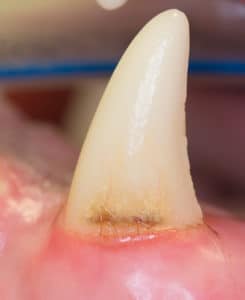
This pet has mild gingivitis, observed as the reddish area where the tooth with the plaque on it meets the gums

More advanced tartar and plaque is causing gingivitis in this dog. You can see the gingivitis as the reddens gums above the teeth. These teeth should have been cleaned long before it got to this stage.
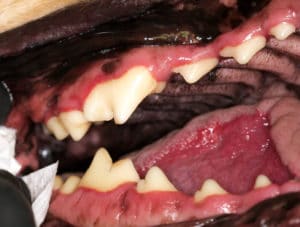
These are the same teeth after they have been thoroughly cleaned and polished
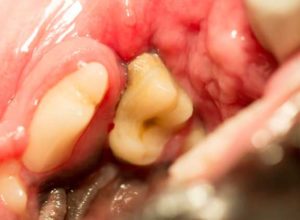
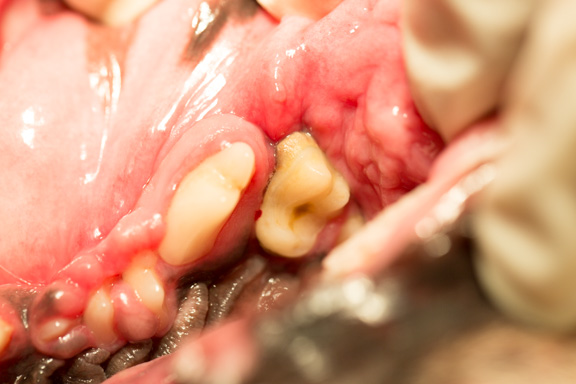
This dog has advanced gingivitis, that reddish area of the gums around this molar tooth
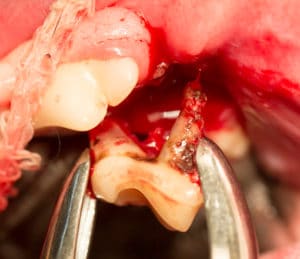
In reality, the problem is even worse. Digital X-rays showed us a rotten root, that can be seen in this picture when this painful tooth is removed under anesthesia.

This mild amount of gingivitis in a cat is called a neck lesion. The root in this tooth is rotten and painful.
If gingivitis is left untreated the inflammation moves into the root of the tooth (periodontal disease) and can cause pain and tooth loss. Eventually, bacteria from this infection enter into the bloodstream and can cause serious disease to heart valves, liver, and kidneys. This pet might be lethargic, coughing, have breathing difficulty, or have a general appearance of poor health. This problem requires special care before, during, and after the time we resolve the problem. Pre- anesthetic diagnostic tests are needed to assess the damage to internal organs. This pet also needs antibiotics before its teeth are cleaned, and intravenous fluids to minimize anesthetic risk.
Diagnosis
Dental disease is diagnosed by a veterinarian only after a complete exam is performed and the principles of the diagnostic process are followed. It is important that a veterinarian makes this diagnosis since there are some diseases that can mimic the symptoms of dental disease, but have different causes and treatments. Also, many pets need to be treated with antibiotics prior to teeth cleaning in order to minimize damage caused by the spread of bacteria to internal organs. Since dental disease is common in geriatric pets we routinely recommend diagnostic tests prior to anesthesia and teeth cleaning, to assess the status of internal organs.
We make our diagnosis by visual observation, probing the teeth with a special instrument, and performing digital X-rays so that we can assess the health of the tooth below the gumline.
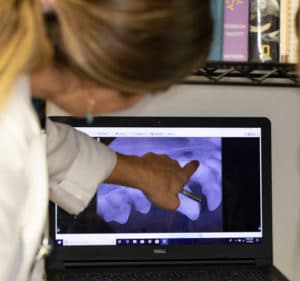
The advent of digital radiology has greatly enhanced our ability to find painful and rotten tooth roots that will be missed upon routine exam
Pre Anesthetic Tests
Careful pre anesthetic preparation of your pet results in almost nonexistent problems when the teeth are actually cleaned under anesthesia. We can perform routine tests in our hospital to give us information on your pets internal status.

We have a special blood machine that gives us a report in 30 minutes
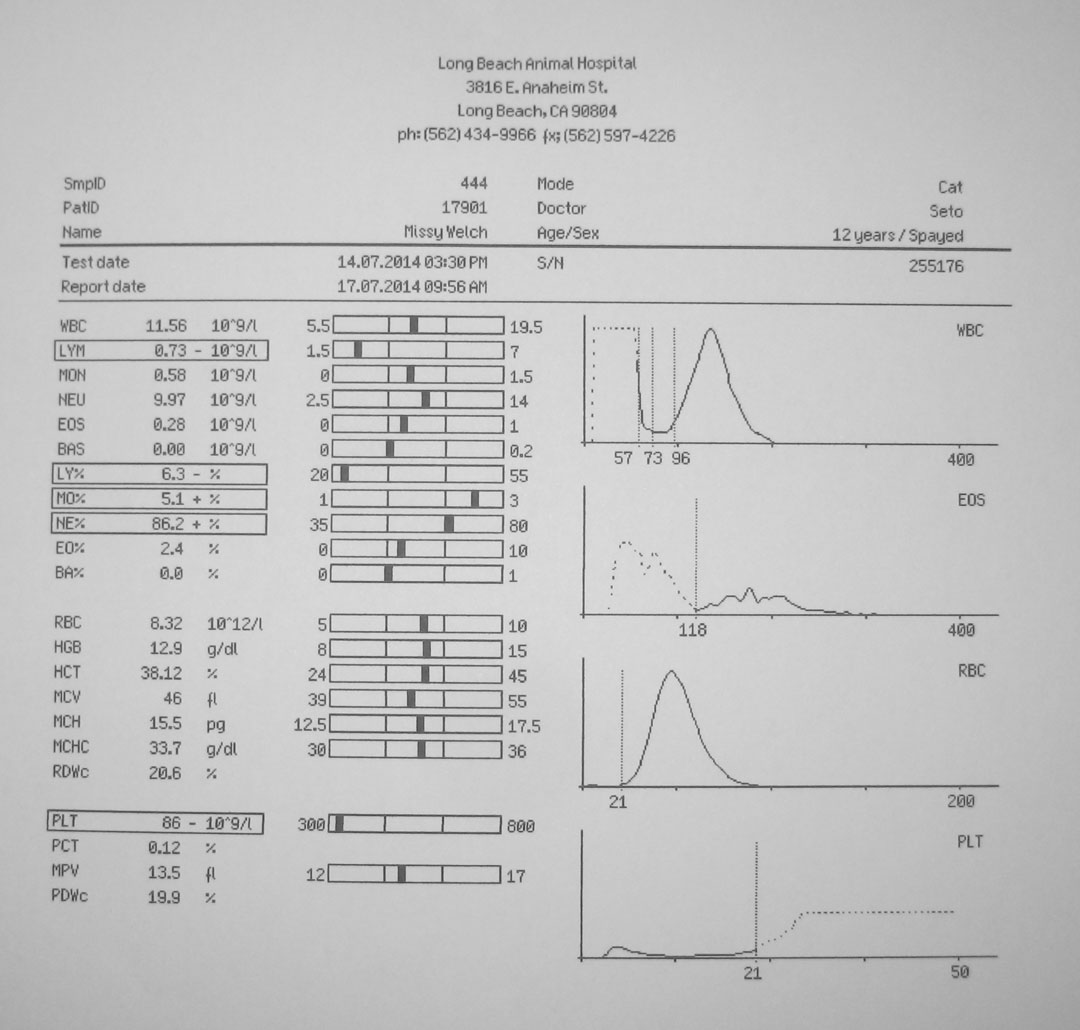
Here is a typical report from this machine
You can learn much more about pre-anesthetic tests at this link
Anesthesia
We have extensive experience at anesthetizing pets for teeth cleaning, especially the geriatric (older) pets that commonly have this disease. All pets that are anesthetized are monitored by several different types of sophisticated equipment. These instruments warns us of problems before they cause any detrimental affects to your pet.
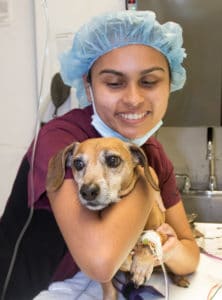
Our anesthetic patients get plenty of TLC before being anesthetized
We keep a close tab on important physiologic parameters for all of our surgeries. Monitors like this give us an early warning of an impending problem.
 During the procedure we are able to monitor many important physiologic parameters
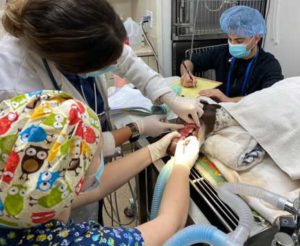
When we clean your pets teeth under anesthesia we have a team of people working together to monitor anesthesia
We have a complete page dedicated to anesthesia if you follow this link.
Treatment
We do more than just clean the teeth once your pet is anesthetized. We probe under the gums for pockets, put fluoride and enamel hardeners on the teeth, and polish them to slow down the recurrence of plaque.
After your pet is anesthetized, the tartar is gently removed by scaling using ultrasonic vibrations. This gentle and thorough method allows us to achieve the important goal of removing tartar under the gum line. If this disease process under the gum line is not addressed, your pet’s teeth will not be adequately cleaned. This must be done under anesthesia so that it can be done properly, and with no anxiety or pain to your pet.

We check the gums of all of the teeth carefully for any pockets or loose gums

We remove the tartar with an ultrasonic scaler

We apply a special antibiotic sealer when the gums are loose and it is possible to save the tooth

After the tartar is removed the teeth are polished to make it more difficult for food debris and bacteria to start the process of tartar formation again.
Applying fluoride is the last step in the process of preventing recurrence
After its teeth are cleaned, your pet should be brought in for an exam by one of our doctors every 6-12 months, depending on how fast tartar accumulates on its teeth.
Non Anesthetic Dental from Pet Dental Services
If one of our doctors determines that your pet’s dental disease (gingivitis) is mild, we can usually correct the problem without anesthetizing your pet. We recommend starting your pet on this at an early age, before any gingivitis starts, and doing this every 6 months. This will prevent gingivitis and periodontal disease, and your pet will not be painful or need to be anesthetized for major dental work.
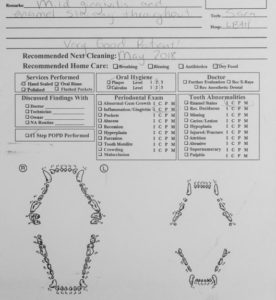
This non-anesthetic dental is thorough, and a chart of your pet’s teeth, with results of the oral exam and treatment, will be given to you
Prevention
The best way to slow down the recurrence of tartar is to feed hard food and brush your pets teeth. If you do not brush your pet’s teeth then you are not providing the long term care your pet needs.
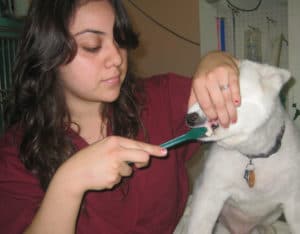
Brushing your pet’s teeth is not as hard as you might think, especially when started at an early age. Our staff will demonstrate the proper technique.
We have dental kits that allow you to clean your pet’s teeth and stimulate its gums without causing undue stress to you or your pet. These kits contain special toothpaste that will not upset your pet’s stomach and will provide the necessary ingredients to remove the plaque that leads to gingivitis.

Most pets take to having something placed in their mouth if started at an early age. The key to the process is in proper restraint. One of our technicians will gladly demonstrate the proper method of performing this important health measure. It is one of the most important health measures you can perform on your pet, and takes minimal time and expense. Proper teeth cleaning at home will minimize the recurrence of gingivitis and increase your pets quality of life. It will also minimize the number of times we have to anesthetize it and clean its teeth.

What is the next step
If one of our doctors feels your pet needs to have its teeth cleaned there are several steps you should take:
1. Make an appointment to have the teeth cleaned before you leave our office. This will give you greater flexibility in your scheduling and allow us to accommodate you as much as possible. One of our receptionist’s will give you a written price estimate based on the doctor’s written instructions. Even though our estimates are very accurate, there may be slightly greater (or even lesser) charges on the final bill. This might be because some teeth need removal or medication needs to be sent home, or even finding something on the oral exam while under anesthesia that was not readily visualized during the initial exam. If there is any significant change in the price we will call you before proceeding. Please leave a phone number where you can be reached.
2. If one of our doctors feels your pet needs pre anesthetic diagnostic tests, have them obtained while you are here, or drop your pet off and return to pick it up later when the tests are complete. The test results will be available the following morning. Please call our office to obtain them after 10 AM
3. The night before the teeth cleaning take away all food and water before you go to bed, and make sure your pet does not eat anything in the morning. Our office opens up at 7:30 AM for drop offs. Please do not bring your pet in for its teeth cleaning past 9 AM.
4. We will anesthetize your pet and clean its teeth sometime in the morning or early afternoon. Please call our office in the mid afternoon to verify it will be going home. The best time to pick up your pet is between 5-6 PM to make sure it is fully awake from anesthesia. It is very rare for a pet not to go home on the same day its teeth are cleaned. Your doctor will let you know if he plans on keeping your pet overnight. This might be because your pet it older or has a medical problem that requires us to monitor its progress in the hospital for an additional night.
5. Contact with children and other pets should be supervised by an adult the first night. Give it a small amount of water and soft food an hour after getting home. If it eats and there is no vomiting, give it some more food and water. By the next morning most pets are back to their regular schedule. Please call us the next morning if you have any questions or you feel there is a problem (not eating, very lethargic).
Now that you are more informed about the problem of dental disease in animals the Detailed Dental Page on our website would love to have you pay it a visit.