

Introduction
One of the most common surgical procedures we perform at the Long Beach Animal Hospital in southern California is a cat spay, known medically as an ovariohysterectomy (removal of the ovaries and uterus).
What is ovariohysterectomy spaying in cats?
This is a surgery where the ovaries and uterus are removed from a cat.
Benefits of having your cat spayed
- It prevents cats from going into heat.
- It prevents cats from getting pregnant.
- It significantly helps prevent cats from getting breast cancer later in life.
- It prevents cats from getting uterine infections later in life.
We have pictures at the end of this page of complications like cystic ovaries and an infected uterus that can occur in unspayed female cats.
In addition to these medical reasons spaying prevents unwanted pregnancies, a significant problem in our society. Millions of cats are euthanized every year because they are strays.
What is the best time to spay an indoor cat?
We usually spay a cat when it is around 6 months of age. This timetable is variable, the important point is to perform the surgery before it goes into heat. Increasing daylight encountered in late winter and early spring stimulate female cats to go into heat.
On the day of surgery we need your cat in the hospital between 7:30 AM and 8 AM. Please take away all food when you go to bed the evening before surgery. Let your pet have water during the night. Do not give your cat anything to eat or drink the morning of surgery.
Our surgeon will call you after the surgery is complete and your cat is awake. It can go home in the late afternoon the day of surgery. Please call our office at 4 PM for pickup time, you will be given written post operative instructions then. We are open in the evening if you need to pick up later.
Neutering Surgery
Anesthesia
Pre-anesthetic preparation is important in every surgery we perform, no matter how routine. All of our spays receive a physical exam prior to surgery. After this exam will we draw a small amount of blood for an in-hospital pre-anesthetic test.
When everything is to our satisfaction we will administer a sedative. This will calm the pet down and make the administration of the actual anesthetic, along with post operative recovery, much smoother. Once a pet is anesthetized, prepared for surgery, and had its monitoring equipment hooked up and reading accurately, the surgery can begin.
 This is a sterile abdominal surgery, and our surgeon starts the pre-surgical process by using special soap to clean his hands
While our patient is being anesthetized our surgeon is already in our surgical suite setting up instruments. Our surgeon is ready to start before our patient is at a proper plane of anesthesia. Once the anesthetist gives the green light the surgery starts immediately. We want our surgeon waiting for his patient, not the other way around. All of this is to minimize anesthetic time.

Our doctors are gloved and masked first before our patient is ready for surgery

Instruments are checked for sterility and prepared for surgery while our doctor is waiting for the final prep and given an OK from the anesthetist to proceed
We keep a close tab on important physiologic parameters for all of our surgeries. Monitors like this give us an early warning of an impending problem.
This machine monitors:
Temperature
Heart Rate
Heart rhythm
Oxygen saturation
Carbon dioxide level
Respiratory rate

In addition to our monitoring equipment our anesthetist stays “hands on” in monitoring important physiologic parameters

We do not rely only on our monitoring instruments, and use the stethoscope manually to check the heart throughout the surgery
Surgical Process
All our spays are performed under sterile conditions. This means instruments and drapes are sterilized by our autoclave, and our doctor wears a sterile cap, mask, gown, and gloves.

Once our patient is draped and in the proper level of anesthesia the surgery begins
The spay procedure begins with an incision in the skin. We make a small one (we call it a bikini scar when it heals) because it minimizes anesthetic time when we have to suture the skin and muscles back together, and to minimize post operative discomfort. Smaller incisions also heal faster and minimize the chance of complications. We pick a specific location on the abdomen to make our incision. This location minimizes skin bleeding, gives us direct access to the muscles we need to go through to get into the abdomen, and puts us directly over the ovaries and uterus.

Our surgeon is making this incision near the umbilicus (belly button) on this cat

Cats have a layer of fat under the skin called the subcutaneous tissue. Once we cut through this fat we expose the abdominal muscles.
It is important to go through the abdominal muscle in the proper location. This location is called the linea alba, and is the area where the abdominal muscles meet. Making the incision here will yield almost no bleeding, and gives the surgeon a strong anchor to sew the muscles back together.

We start the muscle incision with a scalpel, then complete it with the scalpel or a scissors, taking special care not to cut any internal organs
An instrument called a spay hook is commonly used to bring the uterus out of the incision through the small opening in the muscle. We gently pull up the uterus until we have the ovary exposed. The surgery is performed outside of the abdomen.

The black arrow points to the ovary

The ligament that attaches the ovary to the bottom of the kidney is gently stretched to allow complete visualization of the ovary and its blood supply

Our surgeon then clamps the blood supply to the ovary with a hemostat (hemo-blood, stat-stasis)

This is a picture of an ovary cyst from a different cat. This is one of the problems that can occur when a female cat is not spayed.

Using special suture material the blood supply to the ovary is cut off. This is repeated for both ovaries

When both ovaries have been cut off from their blood supply the whole uterus with ovaries is brought through the incision site
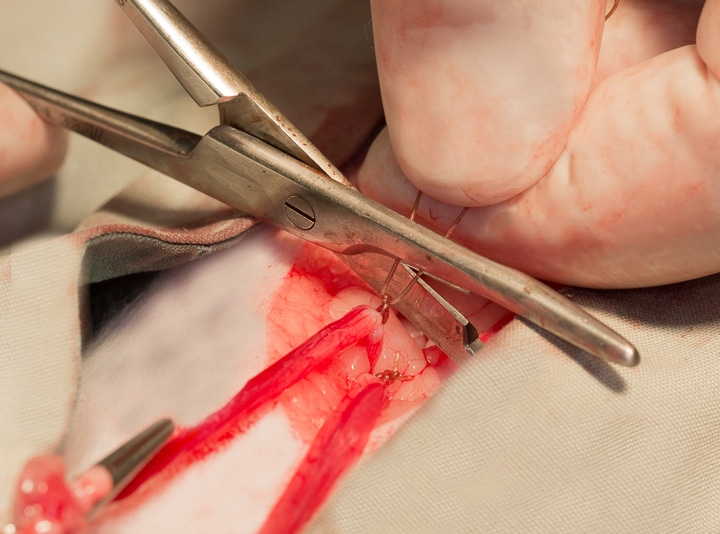
The uterine horns are now ligated with special suture material and cut with a scissors
The muscle layers are sutured at a special section called the linea alba. Our initial incision was made here to facilitate suturing at the end of the procedure. The linea alba is a tendinous attachment between the muscles that holds the suture much better than the muscle itself. This prevents a hernia.

Our surgeon is completing the suturing of the linea alba
The skin is sutured, usually with a suture material that dissolves on its own, so there is usually no need to return for suture removal. We will let you know in your post operative handout.

When sutures are under the skin they make it more difficulty for your pet to lick them out
After the skin is sutured we use our companion laser. This aids the healing process and decreases post operative swelling so your pet is more comfortable.

This is one of several ways we attack any potential pain due to the surgery
Only after we have addressed pain with the therapy laser do we anesthesia and begin recovery
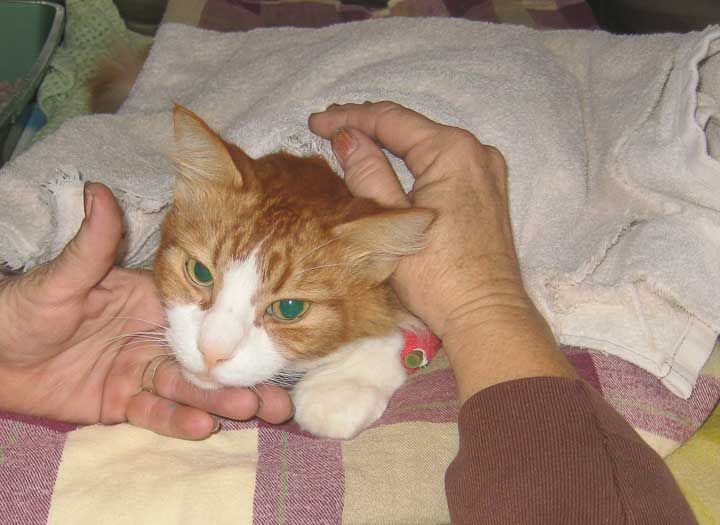
it is moved to recovery to be monitored by our technicians.
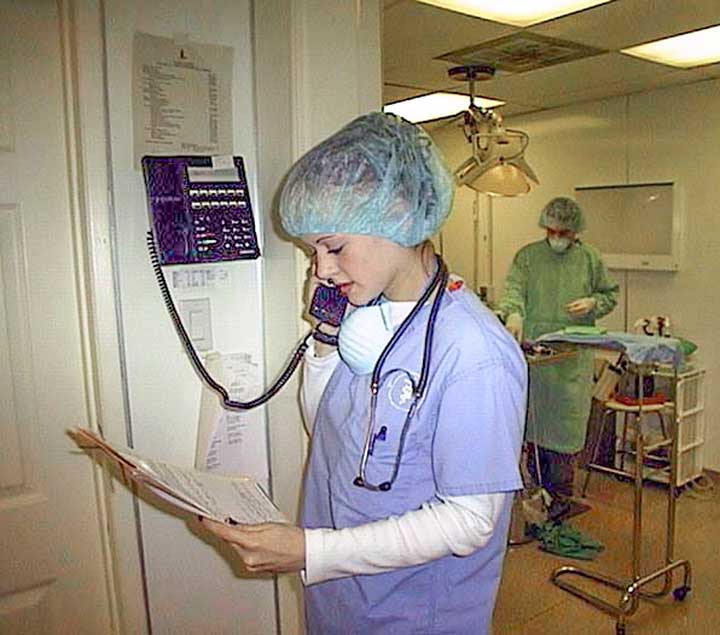
When fully awake we will call and let you know
Unspayed cats are at risk for a disease called pyometra. This is an actual infection of the uterus, and can be very serious. It is diagnosed in several ways, one of them being a radiograph.

The black arrow points to a tubular structure in the abdomen of this cat this is a pus filled uterus
This is what a pyometra uterus looks like. If you look closely you will notice the swollen appearance to this uterus. This is an infected uterus that was removed from an older cat. If this cat had been spayed before its first heat, there is minimal chance it would have had to suffer this infection.

The arrows are pointing to the ovaries
Before it wakes up from anesthesia we will give a pain injection.
Postoperative Care for Cats
Most cats go home late in the afternoon on the day we perform the surgery. They might be groggy from the pain injection which is advantageous because they will remain calm and allow the healing process to start immediately. By the following morning the grogginess will have worn off.
When you first get home do not be in a big rush to feed. after 1 hour at home offer a small amount of food and water. If the appetite is good, offer more several hours later. Do not over do the feeding the first night because anesthesia can make them nauseous.
Use the pain medication we prescribe to make your cat feel comfortable for the next few days.
Keep contact with children and other pets to a minimum the first night, and restrict activity for several days to allow the incision to heal. Do not let your cat go outside until healing is complete.
FAQ’s
What age is too late to spay a cat?
It is never too late to spay a cat, although there will be a much better outcome when your cat is spayed at a young age.
How long do female cats need to recover after spaying?
Most cats recover in a few days, although we prefer you give them a complete week and keep them away from other pets during this time.
Can I let my cat roam the house after being spayed?
If your cat is feeling up to it you can let it roam the house, but only after resting for several days upon returning home. We prefer you wait one week.
Do female cats get more affectionate after spaying?
Spaying does not usually affect the behavior of the female cat.
Will a female cat still mark after being spayed?
It is less likely to mark with urine, although there are other factors here, including other cats in the household.
Do female cats get bigger after being spayed?
Only if it is overfed. If it is overfed and becomes obese it is prone to diabetes mellitus (sugar diabetes) and a liver disease called hepatic lipidosis.
Return to Feline Diseases Page.