

Introduction
The Boxer is a fearless and loyal dog, and a great family pet. It is an athletic dog that also has a wonderful disposition for a family.
They are predisposed to many diseases though, so careful observation of your pets daily routine is important. Any significant change in this routine is cause for an examination.
One of the best ways to catch these potential problems early, when more can be done to remedy them, is a yearly Wellness Exam.
Our web site in the Diseases Section has detailed information on many of the diseases they are prone to.
Degenerative Myelopathy
This is a progressive disease of the spinal cord that starts with weakness in the rear quarters and progresses to partial or full paralysis of the lower limbs.
Any time your Boxer walks like it is drunk, or its rear quarters sway or seem unsteady, it should be brought in for an exam and check for this problem.
Cancer
Boxers are predisposed to a number of benign and malignant (cancerous) tumors that can affect many different body organs, subsequently showing different symptoms.

This slightly inflamed area on the skin is a malignant cancer called a Mast Cell Tumor (MCT)
We can teach you how to monitor for these tumors by running your hands over the skin coat and important organs on a weekly basis, and checking the external lymph nodes for enlargement. We have an In-Home exam checklist to help you perform this exam at home.
Testicular Cancer
Neutering your Boxer at 6 months will go along way to preventing reproductive system tumors. We do all of our neuters by laser, so please visit our web site to learn more about this technique. The laser dramatically reduces post operative pain, swelling, and inflammation.
Skin Conditions
They also get skin conditions, especially allergies. Some of the skin conditions are caused by hormone problems, particularly a low thyroid disease called hypothyroidism. Seasonal Flank Alopecia can also be seen, along with Cushing’s Disease.
Heart Disease
Heart disease is an important problem, especially dilated cardiomyopathy. This is a serious disease and you need to be aware of it by following the cardiomyopathy link. 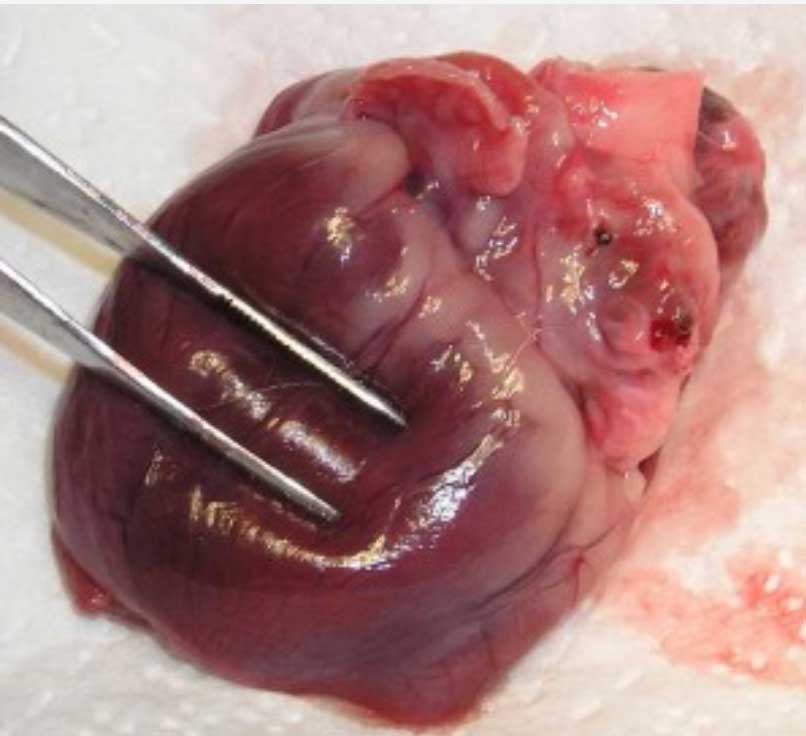
This heart has dilated cardiomyopathy as evidenced by the flabby ventricle under the forceps
Other heart problems include atrial septal defect.
Most heart problems are diagnosed in younger dogs with signs of exercise intolerance and coughing, though heart disease is certainly not the only cause of those signs.
Heart diseases are sometimes detected on physical exam using a stethoscope. If your Boxer does not seem to be an energetic as you would expect, tires easily, or seems excessively tired after mild exercise, this needs to be addressed with a cardiac workup.
Eye Problems (Basement Membrane Disease- BMD)
Boxers are prone to an eye disorder peculiar to the breed known as Boxer Eye in the past. This problem occurs mostly in spayed females and involves ulceration of the cornea that does not respond to treatment. Any time your pet has eye discharge, redness, or is pawing at its eye, an exam should be performed.
Ulcers are a common manifestation of this eye disease, so close observation of any problems with your Boxer’s eyes is important. Check for:
Squinting
Tearing
Pawing at the eye
Redness
Discharge
Bulging
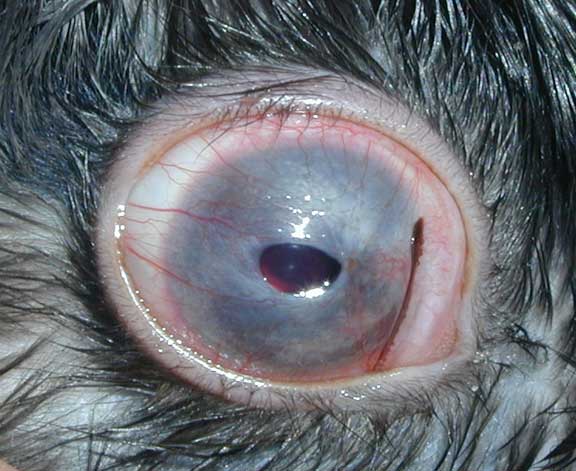
This is a serious corneal ulcer. Any time your dog shows any signs of an eye problem bring it to us immediately so the problem does not progress to this serious state where this dog is in jeopardy of losing its eye.
Histiocytic Ulcerative Colitis
This is similar to Inflammatory Bowel Disease (IBD). You can learn much more about it here. Ultrasound is helpful in the diagnosis.

This is what the small intestines look like during an abdominal ultrasound
Ultrasound is so important in veterinary medicine that the Long Beach Animal Hospital has a complete page dedicated to it.
Bloat (gastic dilatation volvulus)
Deep-chested breeds like Boxers are predisposed to a condition called gastric dilatation, or bloat. If signs of labored breathing, excessive salivation, or distended abdomen occur, your pet might be experiencing this potentially life-threatening condition, and requires immediate veterinary attention.
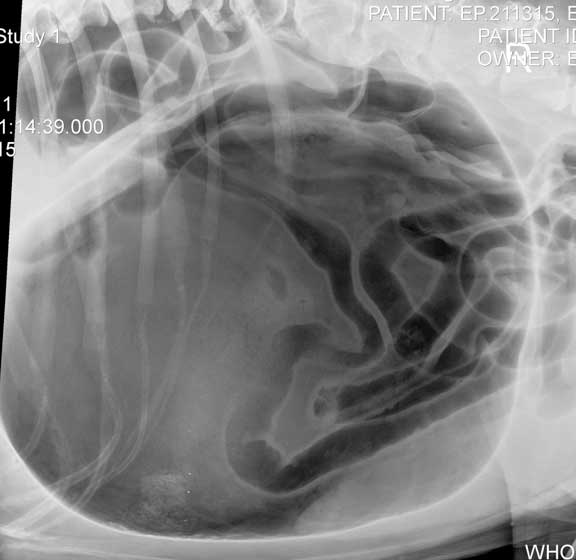
This is the radiograph of the stomach of a dog with bloat. It is twisted on itself, so it also has volvulus.
Disc Disease
Boxers are also prone to herniated discs. Symptoms can vary from a poor appetite and a reluctance to run or jump, to paralysis. They also get arthritis of the spinal cord called spondylosis. This is a painful condition that can be treated to minimize the pain.
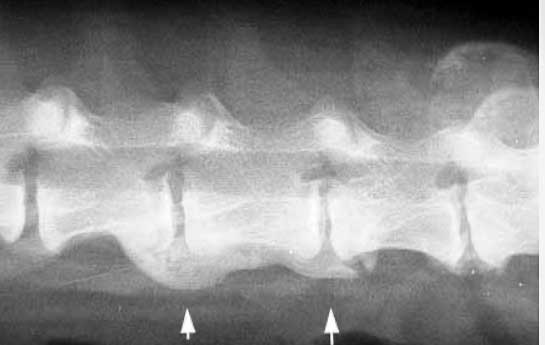
The arrows are pointing to the lumbar spine of a dog with spondylosis, causing symptoms of arthritis
Hip Dysplasia
This is a problem with malformation of the hip sockets that leads to arthritis and significant pain and lameness in many cases.

These hips are normal
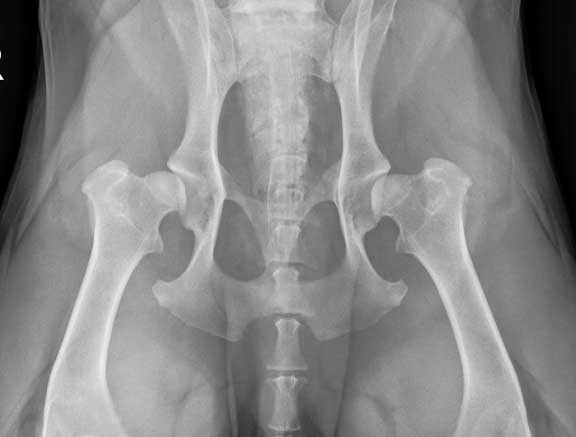
These are dysplastic hips. Can you tell the difference from the normal hips in the radiograph above?
There is much more to be learned regarding this serious disease. Our Hip Dysplasia page has all the details.
Disc Disease (IVD- intervertebral disc disease)
This disease mimics the symptoms of degenerative myelopathy mentioned at the beginning of this page. Disc disease tends to be more acuter and painful, as opposed to degenerative myelopathy that is more chronic and not painful.

The collapsed disc indicative of IVD is outlined in red
Dental Disease
Boston’s are particularly prone to dental disease. It is important to learn how to brush your pet’s teeth while it is a pup so that you are successful at it when the problem starts to arise later. We have a special kit for this purpose, please have one of our nurses show you the proper technique.

If you start early in life it becomes a fun game to play
We also have a food called t/d (it stands for tartar diet) that is a big help if you cannot brush its teeth. Our Nutrition Page has more information.
Wellness Exams
As your pet gets older yearly exams are needed to identify the accumulation of tartar and treat it before it progresses to more serious complications and we have to remove rotten teeth under anesthesia. As tartar accumulates on the teeth we will perform non-anesthetic dentals (this is not a replacement for brushing) every 6 months and hopefully never have to remove rotten teeth under anesthesia.
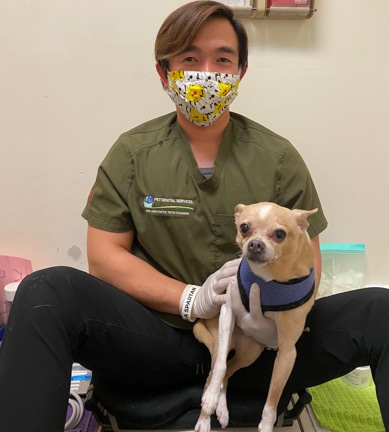
This dog just had its teeth cleaned with Non Anesthetic Dental