

Introduction
The Doberman Pinscher (DP) is an intelligent, alert, and loyal dog that commands a level of respect matched by few other breeds. DP’s are predisposed to many diseases though, so careful observation of your pets daily routine is important. Any significant change in this routine is cause for an examination.
Our web site in the Diseases Section has detailed information on many of the diseases they are prone to.

Dr. P had a Dobie named Watson, who is standing with Dr. P’s grandmother waiting for her to feed him pasta for dinner!
Health Concerns That Affect Doberman Pinschers
Heart Disease ( Dilated Cardiomyopathy)
Dobie’s are prone to several heart diseases. The more common ones are atrial septal defect and especially dilated cardiomyopathy. This can lead to Congestive Heart Failure. This cannot be cured, only controlled with drugs like Pimobendan.
Cardiomyopathy is serious and prevalent, and should be checked for as your dog ages by running an EKG, performing chest radiographs, and having an echocardiogram (ultrasound of the heart) performed by a veterinary cardiologist.

A canine EKG (electrocardiogram)

A chest radiograph to look at the size of the heart

Our cardiologist Dr. Fred Brewer teaching on of the students in our externship program how to interpret an echocardiogram
This is a disease of the muscle of the heart, called the myocardium. It can lead to ventricular arrhythmias ( erratic heartbeats called A-fib in people), and sudden death. Normal heartbeats are interrupted by rapid beats that fire too closely together, subsequently shorting out the heart, and the dog faints.
A Holter monitor, which is a continuous EKG, should be utilized, along with an exam with a veterinary cardiologist, when your dog reaches maturity at 1-2 years of age to look for any signs. Based on that exam your cardiologist will set up a long term plan to monitor for the problem.
About one-third of these dogs have no prior signs of the disease until they die. Some dogs recover, yet some die suddenly.
Any symptom of lethargy, coughing, poor appetite, or exercise intolerance could be a sign of a heart problem and should be investigated.
Our Heart Disease page has details. This page is very thorough and you will learn plenty about cardiology and how complicated the cardiovascular system is.
Endocrine Diseases (Hyperthyroidism)
Hormone problems also occur that cause internal disease. The primary one is low thyroid, an autoimmune diseases called hypothyroidism. Autoimmune means the body is making antibodies against the thyroid gland.
Symptoms can include weight gain, lethargy, and skin conditions. It is diagnosed by monitoring thyroid levels in the bloodstream, usually the T4 and T3 levels.

Blood panel showing a low thyroid level

Blood panel showing a normal thyroid level after starting on Soloxine
It is a treatable disease using the drug Soloxine (Levothyroxine), given on a daily basis.
Red Blood Cell Diseases (Von Willebrand’s)
Problems with the red blood cells are not uncommon. This can cause anemia and bleeding disorders (the most common one is called Von WIllebrand’s). Watch for lethargy, easy bruising, nosebleed, bleeding gums, bleeding in the stomach, limping, or blood in urine or stool.
Von Willebrand’s cannot be cured, and is often treated with a blood transfusion to give your Dobie a good quality of life.
This disease can be tested for, and any dog that is positive should not be bred.
Perform a weekly exam of your DP’s mucus membranes (gums) to make sure they are pink and that there is no petechial hemmorhage.
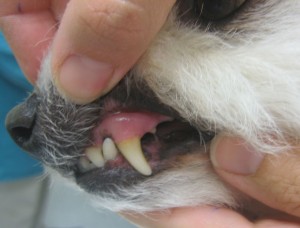
The gums on this dog are nice and pink, just the way we want to see them
Our Learning Center located on the Home Page shows you how to do an in-home exam to check for this.
Gastrointestinal Diseases- GDV (bloat)
Bloating, known as gastric dilatation-volvulus is a problem to be on the alert for at all times. Your dog might be lethargic, have stringy mucous from its mouth, or quite distended. If you see these symptoms consider this an emergency and get immediate care since this is a life-threatening disease, and the earlier the treatment the better the prognosis.
Causes are suspected to be:
- Rapid eating of one large meal
- Drinking excessively just after this meal
- Exercising vigorously just after this meal
The stomach becomes distended with air or gas. This is the bloat or distended part. If it becomes twisted, that is the volvulus part of the name of this disease.

This radiograph of a dog shows the distended stomach
If it is just a bloat the problem might be treated by passing a stomach tube to relieve the distention.
If the stomach twists on itself while distended the air cannot get out. This causes your Dobie to go into shock, and the lining of the stomach can lose its blood supply. Death will ensue rapidly if emergency care for shock, and surgery to unwrap the distended stomach, is not immediately instituted.
We are available for emergencies 7 days per week (except legal holidays), and if your dog is showing any of these symptoms always call us first so we can be prepared upon arrival.
We can potentially prevent this when we spay a female by tacking down part of the stomach.
Hip Dysplasia
This bone disease of the hips can be crippling, and lead to long term arthritis and pain. We have a detailed page dedicated to it.

These dog hips do not show any major signs of hip dysplasia

This is a severe case of hip dysplasia
When purchasing a Dobie make sure it is from a line of parents that are certified hip dysplasia free from the Orthopedic Foundation for Animals (OFA).
Progressive Retinal Atrophy (PRA)
Eye problems can occur at many different ages. Some involve the eyelids while others involve the internal structures of the eye. In some cases symptoms are apparent, while others need a thorough ophthalmic exam.
In PRA there is gradual deterioration of the retina, the back part of the eye that senses light. This needs to be diagnosed early by a veterinary ophthalmologist to be able to help your dog adapt to the gradual loss of eyesight.
You can learn more about PRA by clicking here.
Wobbler’s Syndrome (Cervical Instability)
In this inherited there is a problem with the stability of the cervical (neck) vertebrae. Symptoms range from neck pain, instability when walking (ataxia) to paralysis of the rear legs.
Two view neck radiographs are the first step in this diagnosis, followed by MRI and CT scans.

The first view of the neck is called the ventrodorsal (VD) view. In this case the dog is laying on its back, with the head towards the top.

The other view is the lateral view, where the dog is laying on its side
Chronic Active Hepatitis (Liver Disease)
This is a progressive live disease that tends to occur more often in females. Abnormally high levels of copper are implicated in this problem. Eventually the liver becomes scarred leading to liver failure.
It tends to start in middle age, and genetics might predispose a Dobie to this disease.
Symptoms include weight loss, weakness, fatigue, vomiting, diarrhea and abdominal pain.
As the disease progresses the abdomen might swell with fluid (called ascites), and jaundice (icterus), and confusion/altered consciousness (due to high ammonia levels in the bloodstream) can occur.

This yellow coloration of the gums is what jaundice (medically called icterus) looks like clinically

Blood panel showing high liver enzyme tests consistent with liver disease

Blood panel showing high bile acids test confirming liver disease

Radiograph of the abdomen showing an enlarged (the crescent shaped white image on the bottom) liver called hepatomegaly

Ultrasound of the liver showing a cancerous mass
Ultrasound is a big help in diagnosing a liver problem. A biopsy of the liver can be taking via ultrasound, negating the need for an invasive exploratory surgery.

A typical histopathology report from a liver biopsy

Liver disease is complicated, and it is common to consult with a specialist when liver disease is suspected
The liver is a very complex organ. We have a detailed web page that goes into liver disease in more detail. Click here to view it.
Skin Disease
Several skin diseases have been reported in Dobies. They are susceptible to bacterial and fungal skin infections, inhalant and food allergies, along with several diseases in which the immune system behaves inappropriately. Symptoms include lots of itching, hair loss, and smelly skin, in addition to chronic ear problems. These can be chronic in nature so early diagnosis and treatment is imperative.
They are prone to a large number of cancers that can be of the skin, lymph nodes, reproductive organs or internal organs. Cancer in DP’s can cause many different symptoms, so diligence in checking for any problems in home and prompt examination is imperative.
Kidney Diseases
A kidney problem can occur starting as early as one year of age. Pets with this problem might be drinking and urinating more than usual. Early care is important due to the chronic nature of this disease.