

What is a Ringworm Infection?
Ringworm is caused by a fungus, not a worm, and the lesion is not always in the shape of a ring. The scientific name for this disease is Dermatophytosis because it is caused by a dermatophyte.

This circular lesion might be caused by Ringworm, then again, Ringworm might not be the cause
This fungus grows on the skin, and uses the superficial layers of skin, the hair, and the nails as a source of nutrition.
Since fungi are everywhere in our environment, it is difficult to determine what pets will develop the problem. The fungus that causes Ringworm can be cultured from the hair coats of normal dogs. These pets might be carriers of the disease to other pets along with people. We tend to see the problem more in young animals.
People will sometimes pick up a case of Ringworm from their pet, but just because a pet has Ringworm does not necessarily mean that the people that interact with that pet will develop the problem. A dog can transmit Ringworm to a person without the dog showing any symptoms at all.
Any disease that is transmitted from animals to people is called a zoonotic disease, and ringworm is one of these. Since humans can get this disease from their dogs, it emphasizes the importance of One Health, where veterinarians and doctors work together to cure diseases of animals and people.
Causes of Ringworm Infection in Dogs
There are 3 specific fungi of significance in this disease:
- Microsporum gypseum – This species of Ringworm is usually from dogs that dig into contaminated soil.
- Trichophyton mentagrophytes – This species infects dogs and when they are exposed to rodents or the burrows they live in.
In dogs the majority of cases are caused by Microsporum canis. Which of these 3 main dermatophytes causes the Ringworm in dogs depends on geographic location.
How Do Dogs Become Infected with Ringworm
An infected dog can shed thousands to millions of microscopic spores. These spores can infect an animal or person by direct contact, or they can remain in the environment for up to several years and infect a dog when it comes into contact with that environment. Grooming tools, clippers, bedding, and contaminated clothes are a good source of this environmental contact.
These spores can be difficult to kill, all of this adding up to the fact that this is a contagious disease.
Young and long-haired dogs tend to be more susceptible, and any pet that has an abrasion of infections of the skin (called a superficial pyoderma) is more susceptible.
Signs of Ringworm in Dogs
The skin lesions that appear with Ringworm are variable, and do not necessarily form a ring. Some dog can have and spread ringworm, but do not have any signs of the disease. When lesions are present they tend to be on the head, ears, and legs.
Typically there will be hair loss, usually in small patches at first. as time goes on the patches may disappear or appear at other locations on the skin. There might be scratching due to itchiness. If the hair loss occurs on the face or feet there is a chance it is due to digging habits or exposure to rodents.

This patch is typical of the lesion seen in Ringworm. A diagnosis of this disease cannot be made based just on the appearance of this lesion because other skin conditions (Demodex for example) can show similar lesions.
- Skin allergies
- Mange
- Skin cancer
- Skin infections
You can learn more about these diseases by clicking here.
Diagnosis of a Ringworm Infection in Dogs
There are several different ways to diagnose Ringworm. All require some type of test because it is impossible to make the diagnosis just by looking at the skin. This concept holds true for all skin conditions; making a diagnosis of a skin disease requires all of the aspects of the diagnostic process.
If a person in a household has been positively identified with Ringworm by their physician it is possible they obtained it from their pet, even if their pet has no symptoms of the disease. This is especially important in multiple dog households. We will culture these pets using the culture technique we describe below, but in this case, we might run a new toothbrush over the hair coat to obtain a sample for culture.
An experienced cytologist at a reference lab can see fungal elements from plucked hairs under a microscope.
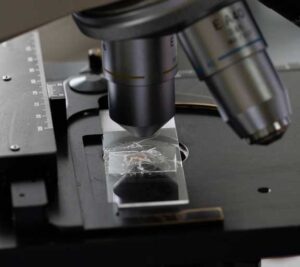
The plucked hairs are examined under high power for any sign of a dermatophyte
One of the simplest ways to diagnose Ringworm is with the Woods lamp, which is an ultraviolet lamp, also know as a black light. 50% of the Microsporum canis species will fluoresce when the Woods lamp is placed near the area of hair loss. This means that although this is a simple and inexpensive test, it is not always reliable.


Another positive for Ringworm. Other material on the skin (dander, medication, etc.) can also fluoresce, so interpretation is important
Since only 50% of a certain species of Ringworm fluoresces under the glow of the Woods lamp, a culture is used to verify the diagnosis:
The first step in the culture process is to gently remove hair follicles in the area of the lesion

These hairs are cultured in a special media that inhibits bacterial growth and enhances fungal growth. This culture can be sent to our outside lab or done in-house. Since a fungus is a slow growing organism it can take up to four weeks to determine if there is growth or not.
The positive culture on the right, from our in-house lab, demonstrates two findings that are needed for a positive diagnosis. The first is the cottonish fungal growth, and the second is the reddish color of the culture media. This color change must occur at the same time the fungal growth appears.

The culture media before adding hairs

A positive culture for Ringworm based on the white fungus and the culture media turning red
Treatment of Ringworm in Dogs
Ringworm is a fungus, which means it is slow growing and slow healing. Medication might resolve the problem in a few weeks, other times it might take months. We typically use the following medications for at least 6 weeks.
In multi dog households we perform fungal cultures on all the other dog that are affected or even unaffected. Even if these cultures are negative for dog that are not affected (called asymptomatic), we oftentimes treat all of the dogs because at some point in time in the near future they might become symptomatic. Even if they never become symptomatic they might become carriers to other dogs.
Topical Shampoos
Topical shampoo therapy is used in almost every case, especially in longer haired pets. It is common to clip some or all of the hair in some pets to make it more effective. These baths will also remove infected hairs that can be the source of an infection to people or other animals.
Shampoos that contain miconazole and chlorhexidene tend to work best. They should be used twice per week.
Cremes
Specific anti fungal cremes that contain miconazole are also used when a pet is infected in an area that already has sparse hair growth, or there are small, discrete lesions. If your dog has a generalized case then these cremes are not as effective.
Another reason cremes are not as effective as shampoo is a dog’s propensity to lick them off.
Dips
Lime sulfur dips can also be effective but are not used as much anymore due to the new shampoos and the fact that lime sulfur smells like rotten eggs.
Oral Medication
Oral antifungal medications are also used in many cases since topical medication alone does not usually cure the problem. These include ketaconazole and itraconazole. Our doctor will let you know if they are needed in your case.
In some pets the disease may resolve by itself.
How Long Does Ringworm Last in Dogs?
An infected dog that is showing symptoms will usually have the problem for at least a month, and sometimes longer, until it if fully healed. There is so much variability here that an exact duration is only an estimate and depends on many factors like immune status, nutrition, genetics, amount of exposure, and stress in multiple dog households.
Decontaminating an Infected Environment
Since fungi are everywhere, it is almost impossible to prevent exposure. Pets that chase rodents, especially into burrows, might be at an increased risk.
It is best to vacuum extensively (discard the bag) and remove anything that might be contained like bedding, litter pans, toys, grooming tools, and food bowls.
Put all of your dogs in one room in the house during the decontamination process to prevent reinfection.
Preventing a Ringworm Infection in a Multiple-Dog Household
Any new dog that is brought into a household should be quarantined for at least several weeks. Brushing the hair coat gently with a toothbrush and culturing the brush, and waiting at least one month for a negative culture is a good way to prevent introducing Ringworm from a new dog.
FAQ’s
1) Will dog ringworm go away by itself?
In some dogs, that problem will resolve on its own.
2) How did my indoor-only dog get ringworm infection?
Any pet or person that goes outside or is exposed to a dog (whether it is showing symptoms or not) can bring in Ringworm spores and infect an indoor dog.
3) Does ringworm make a dog feel unwell?
Any disease makes a dog feel unwell, especially a disease that affects the skin of an animal that is a fastidious licker of its hair coat.
4) Can I put hydrogen peroxide on my dog’s ringworm?
It is not effective, and the bubbling action might stress your dog.
5) How to test for ringworm at home?
You can use a Wood’s Lamp (ultraviolet lamp) to check, but this is not always reliable, as you already learned.