

Introduction
When the neck of the femur is fractured it needs surgical repair. The fracture is almost always from trauma in the cat.
(Joint support supplements for dogs and cats can help maintain mobility during recovery)
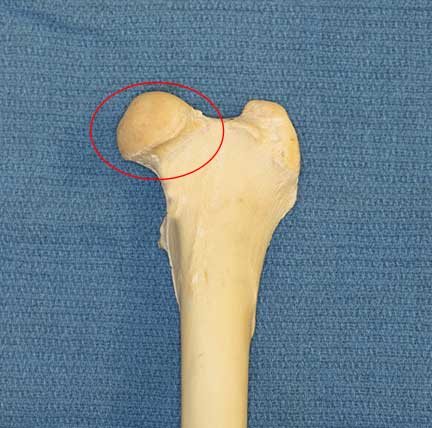
The normal head and neck of the femur are circled in this model. This page will show you how we remove the head when the neck is fractured.
A fractured neck of the femur is the same problem seen in elderly people when they fall and break a hip. Technically, it is not the hip that is fractured, it is the head of the femur.
What is FHO Surgery in Cats?
In the Femoral Head Ostectomy (FHO) the head of the femur, where the ball joint is located, is completely removed. The FHO removes the non-functional head, and allows the body to form a false joint. The cost of this is dramatically less than any other procedure to correct this problem.
We also use this procedure when there is a hip dislocation (called a subluxation) and the hip will not stay in the socket, even when we put it back in and put on a special bandage called an Ehmer sling. We also use this surgery for pets with hip dysplasia that will not be undergoing the more extensive hip replacement surgery called a Total Hip.
Indications for FHO
A cat that is limping in the rear quarters due to a problem with the head of neck of the femur is a candidate for the FHO procedure.
(Pet mobility support harnesses can help assist movement)
In addition to fractures there are other reasons for an FHO surgery in the cat:
Dislocation
Hip Dysplasia
Advanced Arthritis
(Arthritis relief supplements for pets can help reduce joint discomfort)
Legg-Calve-Perthes disease- This is a rare condition in cats where the blood flow to the head of the femur is disrupted and the bone dissolves .
Common Conditions Requiring FHO
Diagnosis
A fractured or dislocated hip in a cat is diagnosed radiographically.

This dislocated hip is obvious
A sling can be used to help hold the ball of the femur back into the socket, but it usually does not work (pet recovery slings can help support healing mobility).
To correct this the head of the femur where the ball is located is cut off, and the femur forms false joint. This is the FHO procedure.
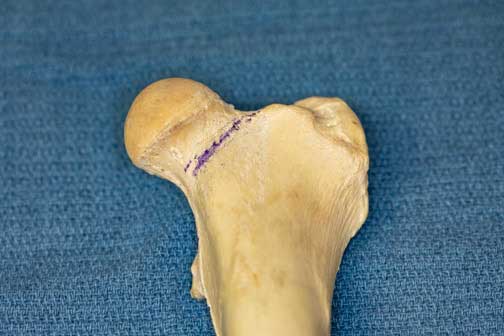
The purple line shows where the surgeon will make the cut to remove the head of the femur
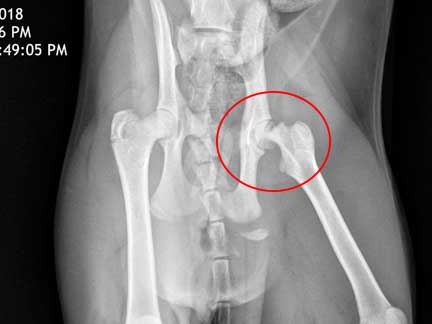
This cat has a fractured neck of the femur
The same procedure is done in this case, although the head of the femur is already cut off from the neck. In this case the surgeon removes the head of the femur that is still in the acetabulum (the socked in the hip where the ball goes into).
Pre-surgical Preparation
Blood Panel
A cat that has been hit by a car hard enough to break a leg might have some internal injuries that are not apparent externally when we perform a physical exam. One test to help us look for any problems is a blood panel.
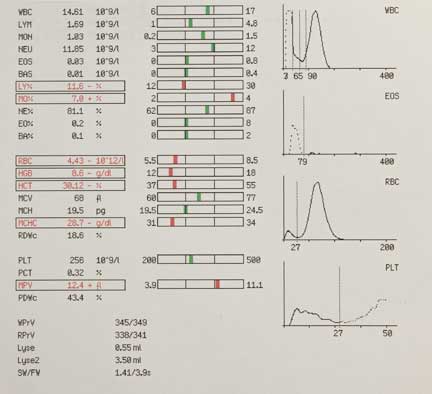
This is one page or our multiple page in-house blood panel. This pet is anemic, so we will be on the alert for internal bleeding

If the anemia is severe enough we will give a blood transfusion prior to surgery
(Nutritional recovery supplements for pets can support strength during recovery)
This is what a diaphragmatic hernia looks like. Can you see it compared to the radiograph above?
Our Radiology page has detailed information on how to read a radiograph if you are interested.
Pre-Anesthetic ECG
Animals that are HBC can have trauma to the heart that is not apparent when we listen with the stethoscope. For this reason we perform an electrocardiogram just prior to surgery.
FHO Surgery Procedure
Anesthesia
Once we have analyzed our pre-anesthetic exam and tests we will proceed to anesthetize our patient. They are given pre-anesthetic tranquilizers and pain medication to calm them down. Our Anesthesia Page has much more information on this.
Monitoring Anesthesia
Our surgeon is one of the best monitors, because he/she is literally visualizing the blood in the circulatory system. Any change in the blood is readily noticed because pets that are breathing 100% oxygen should have bright red blood.
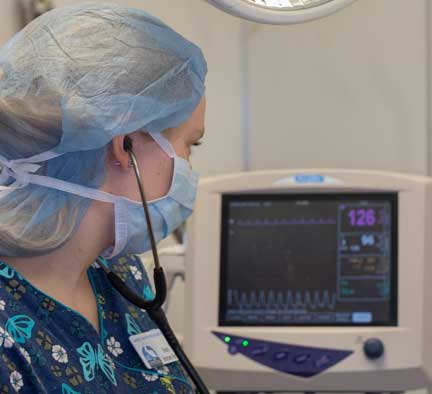
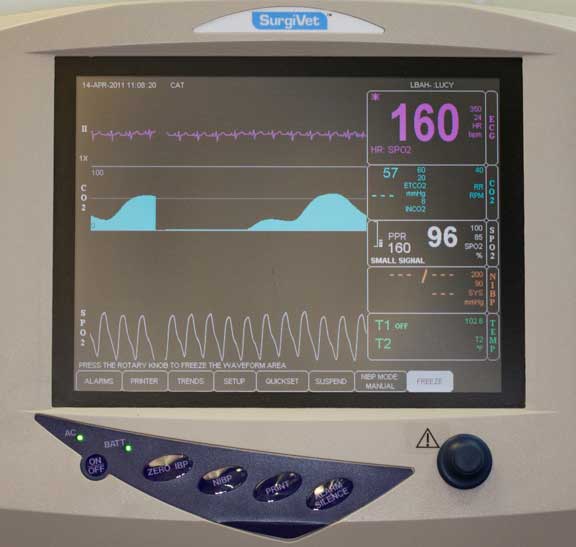
We use a sophisticated monitor to keep track of important physiologic parameters during surgery
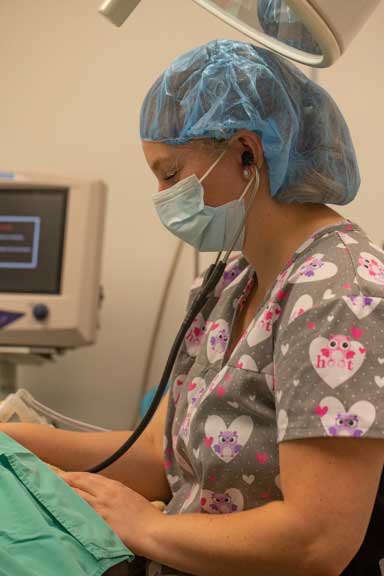
Even with all of that high tech monitoring equipment we still stay hands-on during the whole procedure, even on patients as small and unique as a bird

We keep detailed records of fluid rate rates, anesthetic and oxygen levels, and physiologic parameters, during the surgery
Pre-Surgical Preparation
While our patient is being anesthetized and the hair on the leg clipped and given an initial scrub our surgeon is supervising and preparing himself for the surgery.

While our patient’s leg is shaved our surgeon starts the scrubbing process with a surgical hand scrub to make sure this is an aseptic procedure

He starts with a thorough scrubbing of his nails and hands
And doesn’t stop scrubbing until he reaches his elbows
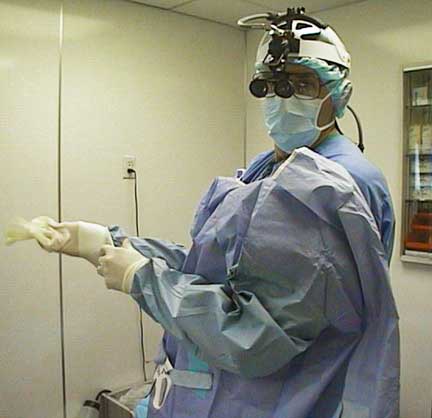
Dr. Cechner gowning and gloving, with his magnifying loop on his head
Patient Prep
When intubated and the initial scrub is completed our patient is brought into surgery and hooked up to our anesthetic monitor. As you view the following pictures you will realize that preparation is a key part of this surgery.
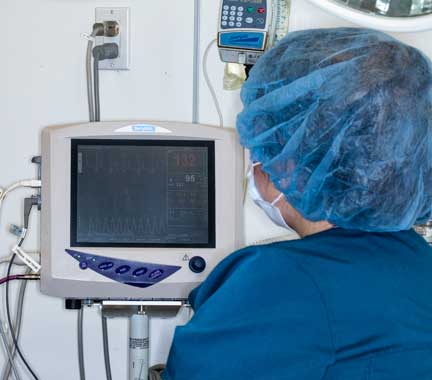
Our nurse anesthetist is monitoring the IV fluids and anesthetic monitor. These fluids are critical to minimize anesthetic risk.
Surgery
As you have just learned, preparation is important. Only once our surgeon is comfortable with the preparation of the surgical site, and our pet is stable and under the proper plane of anesthesia, does the FHO procedure begin.

He palpates the landmark for the skin incision

Let the surgery begin!

Once through the skin the next layer encountered is the subcutaneous (under the skin) layer, sometimes abbreviated as SQ
The surgical approach goes between several important muscles and tendons in order to gain access to the joint where the fracture is located. These include the biceps femoris muscle, the tensor fascia latae muscle, the superficial gluteal muscle, the deep gluteal muscle, and the vastus lateralis muscle.
The muscles and tendons are not cut in order to gain this access to the joint. Careful dissection is performed in this area to preserve the normal anatomy, and not interfere with important nerves and blood vessels This is one of the most difficult parts of the procedure, and where the experience of our surgeon comes into play.

Dr. Cechner is carefully dissecting through all these layers of muscles and tendons

After much careful dissection Dr. Cechner has the head of the femur exposed in the center of this photo. It is difficult to see because it is covered in scar tissue. On the left is the special oscillating saw that will cut through the neck of the femur. The opening is small, so our surgical assistant on the right is using a retractor for better visualization.

The oscillating saw gives a quick and precise cut with minimal bone trauma

The appearance of the head of the femur just before the cut is complete

A special rongeur is used to smooth off the bone incision

Now the long process of suturing everything back together begins

The postoperative radiograph
Pain Medication
Any time we cut bone we make sure our patients have proper post-operative pain medication. This starts prior to the surgery, continues during the procedure and immediately after. Our patient is given a pain injection before going home, and sent home on oral pain medication.
We have a page on all of this called Care of the Surgical Patient.
Think of us as your Long Beach Animal Emergency Center to help when you need us for everything from minor problems to major a major emergency. We serve all of Los Angeles and Orange county with our Animal Emergency Center Long Beach, and are easily accessible to most everyone in southern California via Pacific Coast Hwy or the 405 freeway.
If you have an emergency that can be taken care of by us at the Animal Emergency Hospital Long Beach always call us first (562-434-9966) before coming. This way our veterinarians can advise you on what to do at home and so that our staff and doctor can prepare for your arrival. To learn more please read our Emergency Services page.
If you would like to learn much more about how we do surgery at the Long Beach Animal Hospital, including pre-anesthetic testing, anesthesia, and surgical concepts, please visit our Surgical Services web page.