

Introduction
Hip dysplasia is a congenital disease of the hip sockets.
What is Feline Hip Dysplasia?
Hip dysplasia is a laxity in the socked of the hip joint where the head of the femur fits into the pelvis. It causes weakness and lameness to the rear quarters, and eventually leads to painful arthritis. This arthritis goes by several names; degenerative joint disease, arthrosis, osteoarthritis.
Luckily, this disease is relatively rare in cats as opposed to hip dysplasia in dogs. Some cats might show evidence of feline hip dysplasia on a radiograph, but do not show any symptoms like hindlimb lameness or soreness.
Cause of Hip Dysplasia in Cats
This is a congenital disease, so it is inherited. Several breeds get it more commonly than others:
- Himalayans
- Persians
- Maine Coons
Obesity is a major external factor in predisposing a cat to hip dysplasia. Musculoskeletal problems with the knee, pelvis, and spine and add to the problem.
Symptoms of Hip Dysplasia in Cats
There can be a variety of symptoms with varying degrees of problems. Symptoms can be subtle, so close observation is important. Some of the more common symptoms include:
- Trouble squatting in the litter box, or reluctance to jump into the litter box
- Reluctance to jump on high surfaces like cats normally do
- Staying away from steps and stairs
- Licking or excessive grooming over the lower back and hips
- Irritation or pain when petting towards the rear quarter, or a cat moves away when petted there
- Lameness of one the back legs
How do we Diagnose Feline Hip Dysplasia
Pathophysiology
During the degenerative process the cartilage that lines the hip joint, called hyaline cartilage, is damaged. The damage results from the abnormal forces on the cartilage from the deformed hip socket. Small fractures can occur in the cartilage also. Eventually an enzyme is released that degrades the joint further and decrease the synthesis of an important joint protectant called proteoglycans. The cartilage becomes thinner and stiffer, further compromising its ability to handle the stresses of daily movement and weight bearing.
As the problem progresses more enzymes are released, which now affect the precursors to proteoglycans, molecules called glycosaminoglycans and hyaluronate. Lubrication is negligible, inflammation occurs, and the joint fluid can no longer nourish the hyaline cartilage. This vicious cycle continues until pain occurs. The body attempts to reduce this pain by stabilizing the hip joint.
New bone is deposited at the joint, both inside and out, along with some of the ligaments and muscle attachments to the area. This causes thickening and a decrease in the range of motion. This is the actual arthritis noted on a radiograph, which will not go away, and will continue to progress.
How do we Diagnose Feline Hip Dysplasia?
Symptoms
Feline hip dysplasia is diagnosed based on a history of symptoms consistent with hip dysplasia.
Physical Exam
During a physical exam as we move the sockets around we might elicit pain or feel a grinding (called crepitus) in the hip sockets. We also look for an “ortolan” sign, when the ball comes out of the socket under pressure. Sedation is beneficial to perform this exam accurately.
Radiography
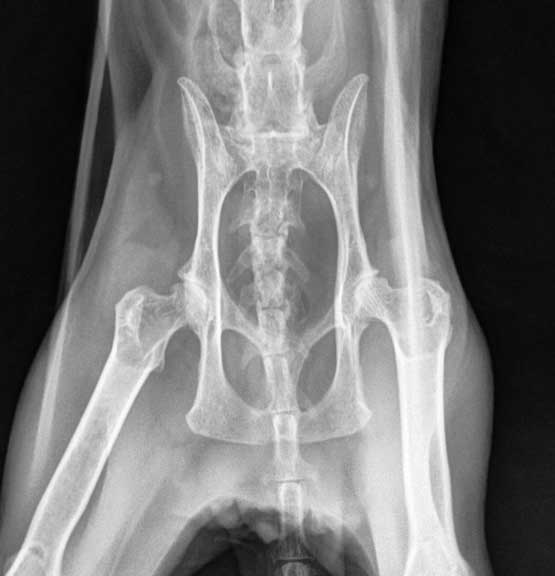
Radiography (X-ray) is the definitive way this disease is diagnosed. In order to make a diagnosis, the pelvis must be aligned, and the legs extended. This is routinely done when a cat is under sedation for proper alignment and interpretation.
We take two views of the pelvis:
- VD (ventrodorsal)- In this view your cat is on its back when we take the radiograph of the pelvis
- Lateral- In this view your cat is on its side

This is the VD view of normal cat hips
This is an elderly cat with hip dysplasia. Can you see the difference in the hip sockets compared to the normal VD view?
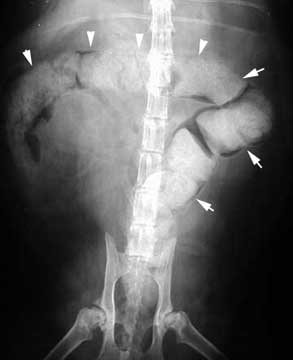
The white arrows outline the large amount of stool in the colon of the above cat with feline hip dysplasia. It is painful for this cat to squat to have a bowel movement, as a result it gets severely constipated.
Treatment of Cat Hip Dysplasia
Medical Treatment
If your cat is obese it is crucial to get it to a normal weight. Not only might this help resolve the problem, but overweight cats are highly prone to diabetes mellitus (sugar diabetes) and hepatic lipidosis (liver disease).
Never give your cat Tylenol (acetaminophen), no matter how little, even though this is used in people and dogs for arthritic pain. This can cause a serious blood disease called methemoglobinemia.
Hill’s Prescription Diets j/d cat food is a complete diet to help the joints. It has hight levels of DHA, omega-3 fatty acids, vitamin E, manganese, and methionine. These supplements can be beneficial, so it is worth trying if you cat eats it. Introduce it slowly over a week.
If your cat has kidney disease, which is common as it gets older just like arthritis from hip dysplasia, then k/d and j/d steer, or kidney / mobility can be beneficial.
Joint supplements like Cosequin or Dasuquin that contain glucosamine might help.
Acupuncture, Laser Therapy, and VNA are excellent treatment choices in many cases because they are effective without the use of drugs. Our Alternative Medicine page has detailed information.
Gentle passive range of motion exercises might help.
An additional treatment modality that has yielded great success in treating hip dysplasia is called VNA. It is a non-invasive and non-painful way to stimulate the nervous system to help the hip dysplasia syndrome. It is used as
This 18 year old dog has been treated with VNA for years and is doing great
Drugs
NSAID’s (Non Steroidal Anti-inflammatory Drugs) are highly effective prescription medications used in people and dogs. They are not good for the long term need for this drugs in a chronic disease like feline hip dysplasia due to their effect on the kidneys. They are usually only used short term (up to 3 days) with a drug called Onsior for more acute pain control.
Surgical Treatment
Most cases of cat hip dysplasia are not treated surgically. One of the surgical specialists we consult with will make the determination of which procedure is the most appropriate. Surgery for cat hip dysplasia is only done of there is substantial pain.
Two main types of surgery are performed on occasion:
-
Femoral Head Ostectomy (FHO) or Excision Arthroplasty
-
Total Hip Replacement (THR)
Femoral Head Ostectomy (FHO) or Excision Arthroplasty
In this procedure the head (or ball) of the femur is removed. The remaining part of the femur forms a false joint with the muscles, ligaments, and tendons in the area. Even though this false joint is not as good as a real joint, there is a significant reduction in pain. Compared to the other types of surgery this one is much more basic, yet many pets that have this surgery return to almost normal function.
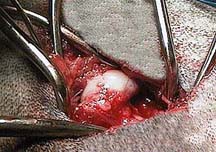
After the skin incision is made the muscles are separated to give visualization of the femoral head. It is gently rotated and brought up as far as possible.
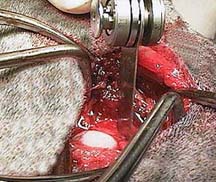
A special air powered drill is used to cut the neck of the femur at just the right angle
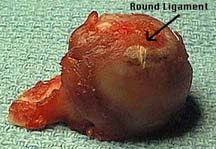
The angle in the cut of the femoral neck is apparent. also present on the head of this femur is a piece of the round ligament, one of the structures that anchors the head of the femur into the socket.
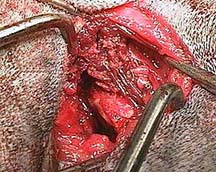
An opening remains where the head of the femur used to reside. The remaining bone will form a false joint, and return this pet to almost 100% function.
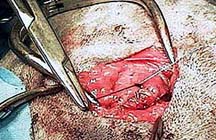
The muscles that were separated and cut are now carefully sutured. These muscles are necessary for normal movement of the false joint that will soon form.
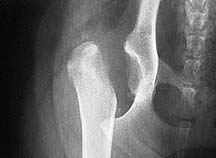
This is what remains after the surgery.
Total Hip Replacement (THR)
This procedure is rarely performed in cats.
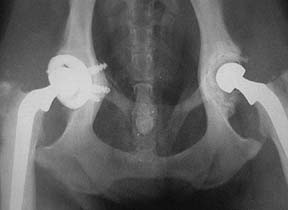
This is the end result of the surgery. These implants now make up the ball and socket joint, and will remain fully functional for many years.
Prevention
Since cat hip dysplasia is inherited there is minimal that can be done to prevent it except to not breed cats with this problem, and keep your cat’s weight normal.
Hip Dysplasia in Cats FAQ’s
Is cat hip dysplasia painful?
Yes it can be, but there is much variability here.
How long will my cat limp after FHO surgery?
Almost all cats with this surgery recover in just a few days since they now have much less pain at the hip sockets.
How long can a cat live with hip dysplasia?
A cat with this problem can lead a long life, so it behooves you to observe your cats habits and behavior closely, and bring it to us for an exam any time you suspect something is just not right. The earlier we start treatment the better.