

Are you providing your cat with the environment it needs? You might think so, but after you read this page you might find some pointers on how you can do a better job. Here, we will tell you how you can enrich your cat’s life.
We are cat lovers at the Long Beach Animal Hospital. After we teach you about how to improve your cat’s life we will show some pictures of the staff in action with some of the tens of thousands of cats we have cared for at the Long Beach Animal Hospital.

Dr. P examining his first leopard at Lion Country Safari in 1983
The main cause of death for cats is euthanasia. This is due to unacceptable behavior in the household. This includes behaviors like fighting, destroying furniture with claws, and inappropriate urination and defecation. When these behaviors become intolerable the cat is either put outside or taken to a shelter for euthanasia. It is all because of a lack of understanding on what cats need to be physically and emotionally healthy. You can learn more about this from the American Association of Feline Practitioners.

If you start socializing them when they are young you will have healthy and happy cats like these two (the paw on the head is a giveaway)
From the health point of view, cats have a protective mechanism that avoids showing outwards signs of illness. This leads to delayed recognition of a problem and a delay in seeking veterinary care until the problem is well entrenched and difficult to correct.
In addition to the extreme outcome of euthanasia, this lack of meeting the basic needs of cats in the home environment predisposes them to disease. Chronic stress is a factor in most of these diseases. Here are some of the more common ones:
Obesity- leads to several diseases, the most important being sugar diabetes (diabetes mellitus).
Lower Urinary Tract Disease (Bladder stones and infection)
GI Disease (Inflammatory Bowel Disease)
Hormonal Disease (Hyperthyroidism)
Inflamed and painful gums (Stomatitis)
Compulsive diseases like overgrooming
Aggressive behavior
Respiratory infections
It all boils due to a term called “environmental enrichment”, the subject of the page.
What is an Enrichment of a Cat’s Life?
This concept attempts to minimize the lifestyle of stalking and hunting prey, which keeps a cat healthy and stimulated at all times (when not sleeping of course, which is their primary activity at times). An enriched cat is a happy and healthy cat, and should be a high priority in cat ownership.
The Importance of Providing an Enrichment Environment for your Cat
An intelligent and keenly sensed animal like a cat depends on a stimulating and enriched environment at home. Without this it is highly prone to manly stress related and metabolic diseases that will decrease the quality and length of its life.
Types of Cat Enrichment
Enrichment involves these 7 broad categories:
Physical
Mental
Sensory
Social
Training
Food
Husbandry
Ways to Stimulate their Senses
- Give your cat places to climb
- Play with toys together
- Give them things to scratch
- Change toys and places they explore
- Give them spots to hide
- Let them check out new places
- Let them spend time with other pets if socialized
- Provide enough litter boxes
Steps to Enrich Your Cat’s Life
Provide a safe haven
Cats need to feel secure about their environment. They feel more secure in raised areas that allows them to observe their environment in whole and from above, and have a place to retreat to so they can feel protected, especially when they get scared. You can use ledges, boxes, and carriers as a start, see if and how your cat uses them, and then adjust from there.
Some cats associate the carrier with a stressful episode like a car ride or a visit to a place like a veterinary office. To alleviate this problem leave the carrier out anywhere in your house and let their natural curiosity allow them to acclimate to it. Put food and comfortable bedding inside to entice your cat to enter it and feel comfortable in it. This acclimation to the carrier has the added advantage of minimizing stress when you need to bring her somewhere because this is her “security blanket away from home”.
In multi cat homes make sure there are lots of nooks and crannies throughout your house that your cat can use to stay away from other cats when it wants. Being out of sight of each other when they want private time also helps.
Set up multiple locations to satisfy important needs
These are the basics like food, water, litter pans and scratching posts. Having these basics in several locations and levels throughout the house minimizes competition, bullying, aggression, and stress, in multiple cat households. Having these things at several locations in a single cat household is also beneficial because it minimizes boredom and stimulates them to be inquisitive, a natural behavior for them.
Don’t be fooled into thinking that just because your cats eat next to each other that there is not substantial stress going on for an individual cat. These cats are tolerating each other, but this is not the optimal environment for them. This adds to the continual stress that makes them more susceptible to disease and behavior problems.
Cats that like each other are affectionate to each other, and show this by grooming and sleeping together.
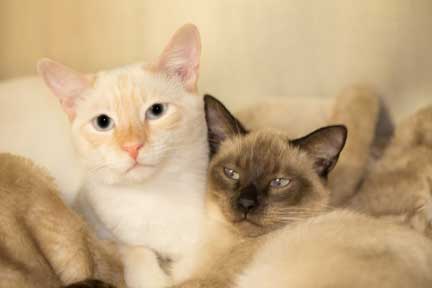
This is how you can tell if your cats truly get along
Set aside consistent time for play
Stalking, chasing, and play are natural behaviors that your cat needs to express daily. In addition to being advantageous psychologically, the physical activity helps prevent obesity, a common and serious problem in cats. Obese cats are much more prone to a liver disease called Hepatic Lipidosis, and also sugar diabetes (Diabetes Mellitus).
Set aside time each day to play with your cats. Consistently is more important than quantity, so even a few minutes of play at a set time everyday is beneficial.
You can stimulate playful activity yourself by using a laser pointer to see if your cat chases it, string with something on the end attached that they can bat with their paws, throwing a ball of yarn on the floor, and even motorized or windup toys if the motion or noise does not scare them. Use your imagination here, and change it up by rotating toys and introducing new ones.
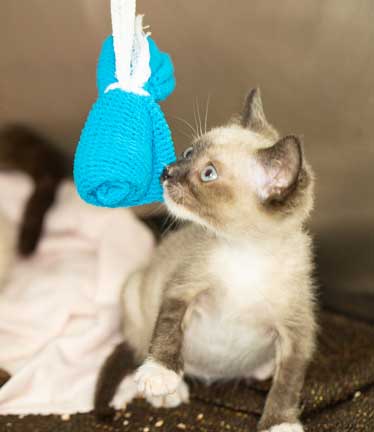
Anything swinging, hanging, or moving, is fair game to get batted
Hiding small amounts of food in different areas, or putting it inside of a feeding toy that they like, stimulates their normal hunting behavior. Work you way up to this slowly by putting only a small portion of its food into these toys. If you cat likes this, and is eating well, you can transition from feeding all of its food in a bowl at once to all of its food in toys and making it look for its food.
It is important to make sure that your cat is eating, because cats are one of the creatures that cannot go a long time without eating. If they don’t eat they can get a liver disease called hepatic lipidosis, especially if you have an obese cat that you are trying to make more active to lose weight by having it hunt for its food, as opposed to putting all of it into a bowl to eat at once.
Let you cat come to you
The time to pet your cat is when it wants to be petted by coming to you. Petting the head area when your cat wants to be petted gives you your greatest chance to make your cat a purring machine. Providing a lot of different human interaction when your cats are young is the way to make them much more affectionate and interested in laying on your lap or sleeping next to you.
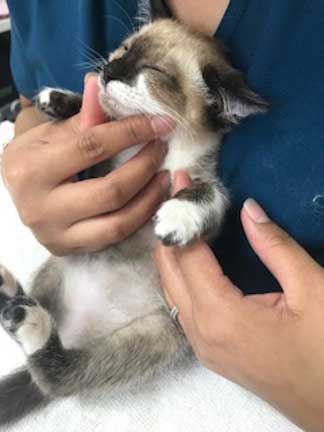
Exposing your kitten to petting time by strangers is a great way to socialize it towards people and make it more affectionate. As you can see this little guy is feeling no pain!
Important senses
As humans our sense of smell is greatly diminished compared to our feline friends. Not only do they have a better sense of smell than we do, they also use this sense to mark their territory, an important behavior for them. Your cat does this by rubbing his face on objects or scratching them. Pheromones used to do this are perceived by other cats in a way that we cannot understand.
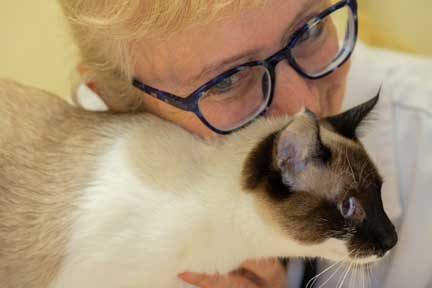
We are not sure who exactly is spreading their pheromones in this picture, our cat crazy doctor, Dr. Kennedy, or her patient
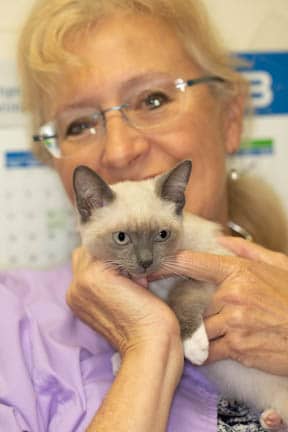
Here she is again putting her pheromones on another cat
You can help here by not using cleaning agents with strong ammonia, not using scented litter, and providing scratching posts where they can mark their territory.
Using products like Feliway that contain calming pheromones can be helpful in many cases.
Minimizing stress for hospital treatment
We pay special attention to our cat patients and try to give them an environment that is as stress-free and natural to their instincts as possible. By minimizing their stress important parameters like temperature and heart rate are more reflective of their true physiologic state, and give us more accurate information for diagnosis and treatment.
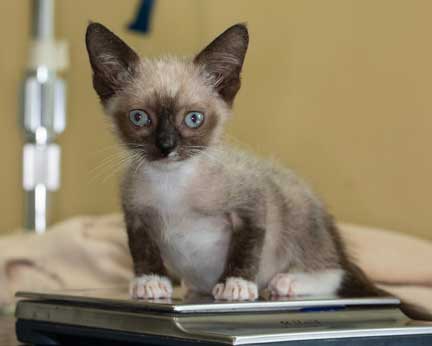
This little guy named Jamal was very ill for weeks in our hospital. Because he is a fighter, and his special needs were addressed by our staff while he was hospitalized, he made a complete recovery.
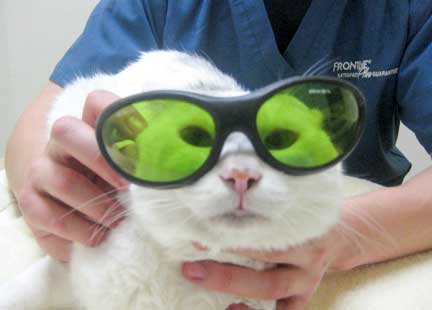
This cat loved wearing the laser glasses when it came in for its weekly arthritis treatment
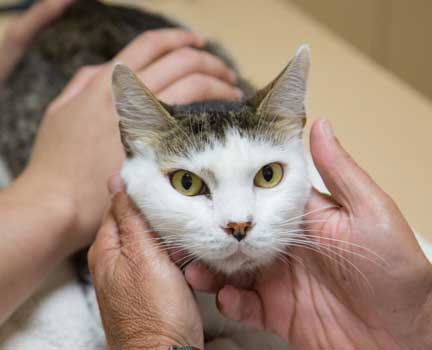
Before Dr. P gives this cat his pre-surgical exam the two of them shared some quality time
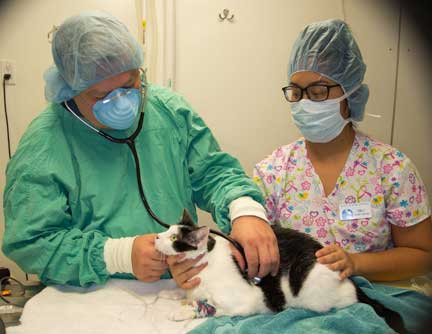
Dr. Ridgeway performing a pre-anesthetic exam on a calm cat, giving us an accurate heart rate
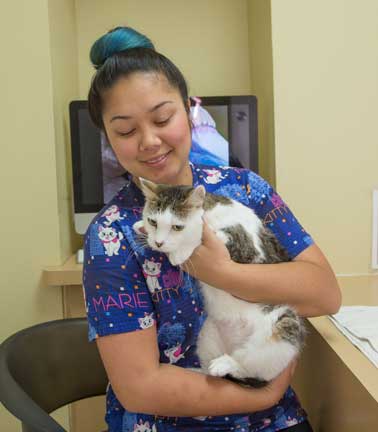
Our nurse Emily finished the job by giving some TLC after the exam
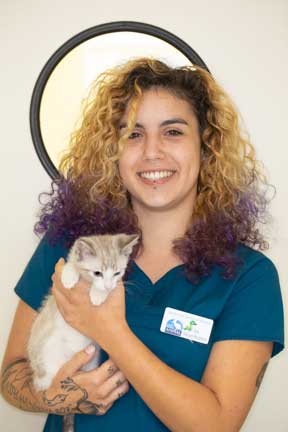
Even our receptionist Carla likes to get into the act
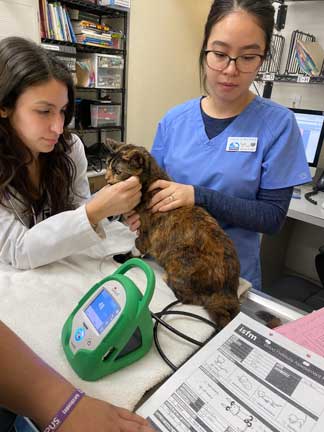
We work extensively with geriatric cats like this one getting its blood pressure checked. To get an accurate reading we need to minimize stress.
Minimizing stress for in home treatment
When your cat is in a healthy and enriched environment, and has been socialized properly, you are doing yourself a big favor if it ever gets ill and needs to be medicated by you.
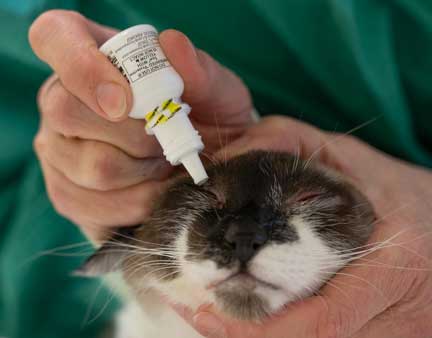
Medications like eye drops are much easier to administer to a well adjusted cat
A few of our feline patients over the years
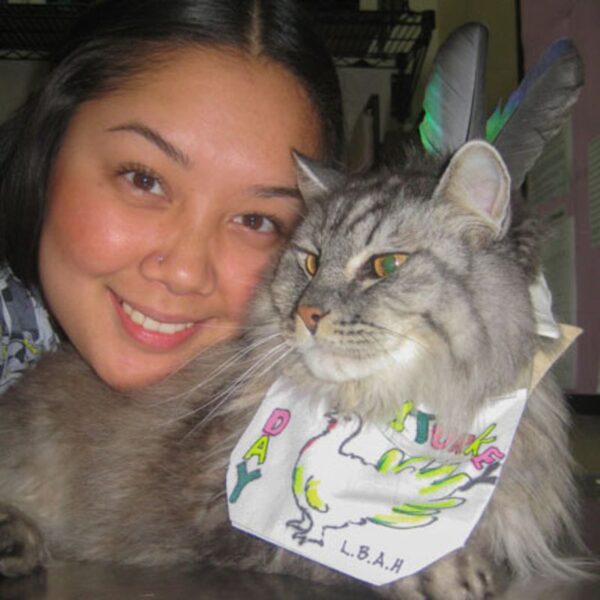
Emily celebrating Thanksgiving with a thrilled Cheyenne
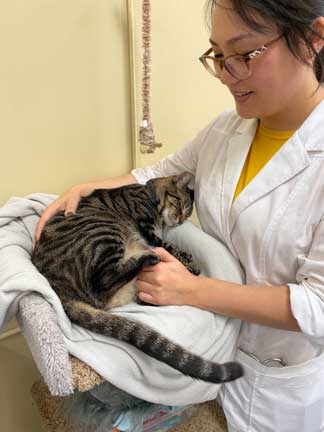
Dr. Y tickling the feet of one lazy mascot named Groot
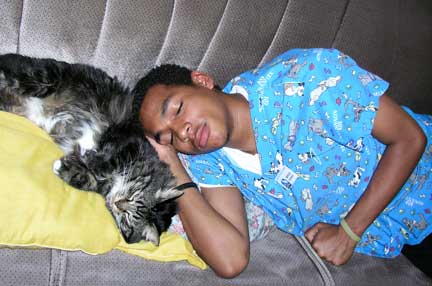
Our hard working staff giving moral support to one of our mascots
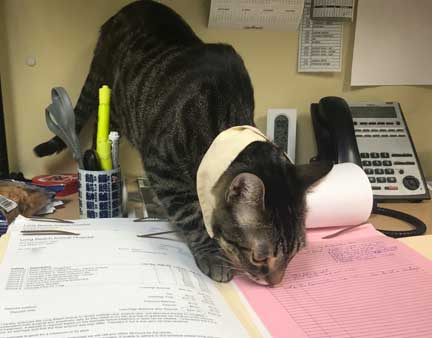
Our mascot Groot reviewing a medical record for one of the doctors
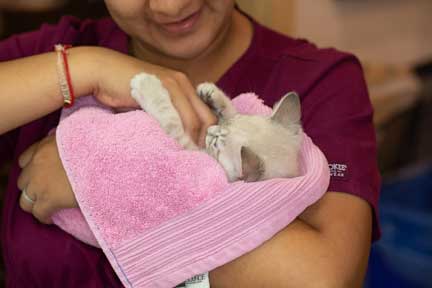
A cozy way to wake up from anesthesia with one of our staff

A cozy way to wake up from anesthesia with one of our student externs
Dr. P works with cats of all different sizes, including this lion that was anesthetized in Kenya for an exam and a new radio collar. This picture was taken on one of the many wildlife photography trips he leads around the world. You are welcome to join him on his next adventure!
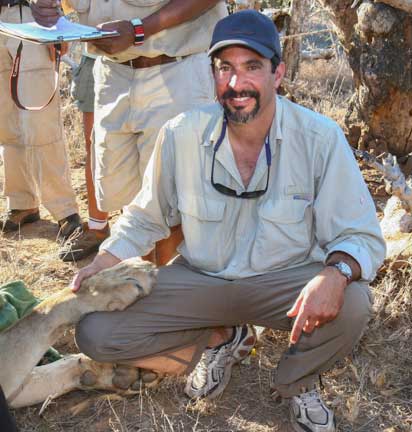
This male lion weighed a wee bit more than the average feline patient we see at our hospital. How about around 500 pounds more!
Return to Cat Diseases page.