

Introduction
It is not uncommon to find a heart murmur in a dog or cat. This page explains what a murmur is and how we diagnose it. You will also learn there is a lot more to a heart murmur than just the sound in regards to how they are classified.
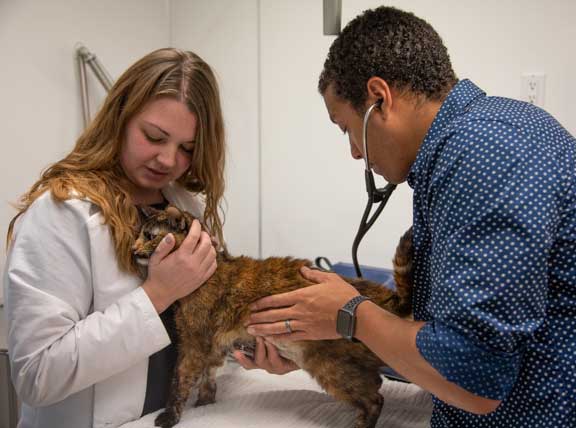
Our cardiologist, Dr. Fred Brewer, is teaching one of our student externs how to auscult the heart with a stethoscope
What is a Heart Murmur?
A heart murmur occurs when there is a turbulence to the normal flow of blood through the chambers of the heart. Sometimes it is so subtle as to be barely detectable with a stethoscope, while other times it is so loud that it can actually be felt by touching the chest wall. Although some murmurs are innocent, especially in young dogs, most indicate some degree of problem.
What is an Innocent Murmur?
This type of murmur occurs in puppies, usually found during an initial physical exam or when it is given its puppy vaccines. It occurs in up to 28% of puppies, and tends to be due to a physiologic anemia due to its young age. The majority of puppies that have innocent murmurs go away as they reach 6 months of age.
If the puppy is fine otherwise, and growing as to be expected, the murmur is watched. If it occurs in future puppy exams, gets worse, or becomes what is called a continuous murmur, then further diagnostics are needed.
Functional Heart Murmur
This murmur can be caused by the following:
- Anemia
- Fever
- Pregnancy
- Hyperthyroidism
- Increased sympathetic tone (fight or flight response)
Heart Murmurs are classified according to:
- Intensity
- Frequency
- Quality
- Duration
- Point of Maximum intensity (PMI)
- Site of radiation
- Pitch
They are also classified according to quality:
- Soft
- Harsh
- Rumbling
- Musical
- Mixture of the above
They are also classified according to shape (configuration):
- Crescendo
- Decrescendo
- Crescendo-Decrescendo
A further classification includes:
- Early systolic
- Mid-systolic
- Late systolic
- Holosystolic
- Early diastolic
- Mid-diastolic
- Late-diastolic
- Continuous
As you can see, there is a lot more to it than just hearing if the heart is beating when using a stethoscope.
How are Heart Murmurs Graded?
Heart murmurs range from 1 -6:
Grade I- Quiet, maybe heard in only one location, maybe intermittent
Grade II- A light murmur that is readily heard
Grade III- A modest murmur
Grade IV- As strong murmur that is easily detected with the stethoscope even by people not trained in the fine art of auscultation
Grade V- A strong murmur that can actually be felt at the chest with bare hands
Grade VI (also called a thrill)- so loud that it can actually be heard without the stethoscope.
Where are Heart Murmurs Located in the Heart?
Heart murmur occur at the valves as the blood flows between the different chambers of the heart. When the flow becomes turbulent the murmur is heard. You can learn more about the heart anatomy and its valves by clicking here.
What Causes a Heart Murmur in a Dog?
The two main causes of a murmur are severe anemia and incomplete closing of the heart valves. The anemia related murmur is not as common as the heart valve problem.
What Heart Valve is Usually Involved?
The mitral valve is the most common one by far. This mitral valve problem is called mitral regurgitation, or more commonly, myxomatous mitral valve disease (MMVD).
This valve gets thickened due to various reasons, especially chronic bacteria from dental disease.
Below is a photo of the mitral valve of a dog. The top arrow points to the normal mitral valve leaflet that is flat. The bottom one should be the same shape so that the two valves form a tight seal when closed. This tight seal prevents the turbulent flow of blood, which is the cause of a heart murmur.
The lower arrow points to a thickened mitral leaflet. This mitral valve does not close completely because of this, and a murmur ensues.
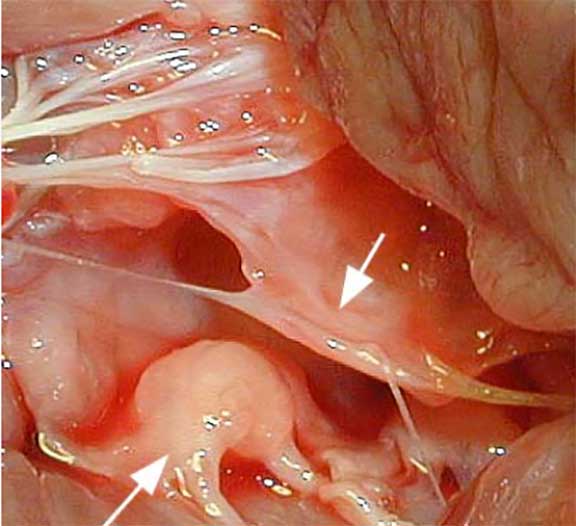
The thickening is apparent at the lower arrow
Other valves are involved with heart murmurs . The diseases that involve them are:
- Subaortic stenosis
- Pulmonic Stenosis
- Ventricular Septal Defect
- Atrial Septal Defect
- Patent Ductus Arteriosus (PDA)
- Tetralogy of Fallot
Listen to a Heart Murmur That We Recorded
Click on the link below if you would like to hear a moderately loud murmur. A normal heart with normal valves opening and closing has a lub-dub sound. The murmur is a whooshing sound, similar to a washing machine:
Tools Needed to Detect a Heart Murmur
Heart murmurs are detected with a stethoscope. This valuable instrument is used often in daily practice and on more than just dogs and cats. To learn how to use this instrument to detect all of the subtleties mentioned earlier in the classification section takes many years to perfect.
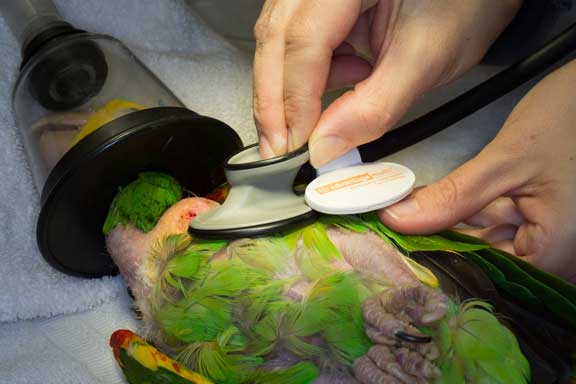
Monitoring the heart of a bird under anesthesia

In a baby howler monkey that decided it wants to eat the stethoscope. This photo is from conservation work Dr. P did in Costa Rica with Dr. Marie Rush. You can learn more about this from his Photography Page.

We even use it on chocolate Easter bunnies!
Murmur can also be “seen” during an echocardiogram. This is an ultrasound of the heart, and with the doppler color flow, the murmur can be visualized. Click on the link below to see this.
Echocardiogram
Symptoms & Signs of a Heart Murmur
Normal Heart Sounds
To begin with, learning how to listen for a murmur takes and understanding of the 2 normal heart sounds that occur as valves open and close in the heart. They are called:
S1- This starts when the heart ventricles contract, and is timed with the arterial pulse
S2- This sound has a higher frequency and shorter duration than S1.
Abnormal Heart Sounds- murmur
Almost all murmurs are detected only with a stethoscope after careful auscultation (listening to the chest with a stethoscope) in a quiet room and with a cooperative pet. As opposed to a human, where the breathing is controlled and the stethoscope is put on a bare chest, a pet that is panting, purring, moving around, and with a thick hair coat, poses a special challenge to say the least.
The skill to be able to hear a murmur in this situation, let alone discern all the features of a heart murmur, takes many years of practice.
Symptoms of a Heart Murmur
Heart murmurs have no symptoms, they are a sign of something going on in the heart that might be normal or abnormal. Heart murmurs do not have any external signs unless very severe. This is technically called a “thrill”, which you learned about earlier.
How is a Heart Murmur Treated?
Since a heart murmur is not a disease per se, but a potential sign of a disease of the heart, there is no one treatment for a pet with a heart murmur. Innocent murmurs go away, some functional murmurs are resolved by treating the problem that caused it, for example, hyperthyroidism.
Some murmurs that are indicative of an anatomical problem with the heart, such as patent ductus arteriosis (PDA), are treated surgically.
If a murmur, especially of the mitral valve, is causing a heart failure called congestive heart failure, it is treated medically.
Prognosis
This all depends if the murmur is causing a significant problem. The prognosis ranges from good in innocent murmurs in puppies, to poor in older dogs with heart failure.
How is a Heart Murmur Prevented?
The only way to help prevent a heart murmur from mitral disease is to keep your pets teeth cleaned. There is no guarantee this will work because your pet might be prone to a mitral valve murmur as it gets older, but it puts odds much more in your favor, and it might actually prevent this type of murmur.